Gender words are used here to talk about anatomy and health risk. Please use this information in a way that works best for you and your doctor as you talk about your care.
Urinary tract infections (UTIs) are most often caused by bacteria. These bacteria enter the urinary tract. The bacteria may come from inside the body. Or they may travel from the skin outside the rectum or vagina into the urethra. Female anatomy makes it easy for bacteria from the bowel to enter the urinary tract. This is the most common source of UTIs. This means women develop UTIs more often than men.
Pain in or around the urinary tract is a common UTI symptom. But the only way to know for sure if you have a UTI is for the doctor to test your urine. The two tests that may be done are the urinalysis and urine culture. These tests tell your doctor if you have a UTI and what type of bacteria is causing it.
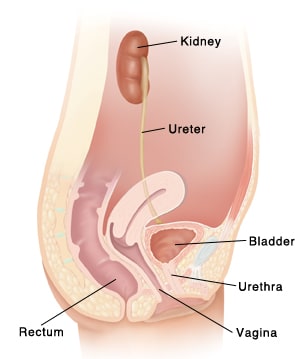
Types of UTIs
- Cystitis. A bladder infection (cystitis) is the most common UTI in women. You may have an urgent or frequent need to urinate. You may also have pain, burning when you urinate, and bloody urine.
- Urethritis. This is an inflamed urethra. This is the tube that carries urine from the bladder to outside the body. You may have lower stomach or back pain. You may also have an urgent or frequent need to urinate.
- Pyelonephritis. This is a kidney infection. It can be serious and damage your kidneys if not treated. You may need to stay in the hospital if you have a severe case. You may have a fever and lower back pain.
Medicines to treat a UTI
Most UTIs are treated with antibiotics. These kill the bacteria. The length of time you need to take them depends on the type of infection. It may be as short as 3 days. You may need a low-dose antibiotic for several months if you have repeated UTIs.
Take antibiotics exactly as directed. Don't stop taking them until all of the medicine is gone, even if you feel better. The infection may not go away fully and return if you stop taking the antibiotic too soon. You may also develop a resistance to the antibiotic. This can make the infection much harder to treat.
Lifestyle changes to treat and prevent UTIs
The lifestyle changes below will help get rid of your UTI. They may also help prevent future UTIs.
- Drink plenty of fluids. This includes water, juice, or other caffeine-free drinks. Fluids help flush bacteria out of your body.
- Empty your bladder. Always empty your bladder when you feel the urge to urinate. And always urinate before going to sleep. Urine that stays in your bladder can lead to infection. Try to urinate before and after sex as well.
- Practice good personal hygiene. Wipe yourself from front to back after using the toilet. This helps keep bacteria from getting into the urethra.
- Wear cotton underwear. Don't wear synthetic or tight-fitting underwear that can trap moisture. Change out of wet bathing suits and workout clothing quickly.
- Take showers. Showers are better than baths for preventing UTIs.
- Use condoms during sex. These help prevent UTIs caused by sexually transmitted bacteria. Also don't use spermicides during sex. These can increase the risk for UTIs. Choose other forms of birth control instead. A low dose of a preventive antibiotic may be used for women who tend to get UTIs after sex. Be sure to discuss this choice with your doctor.
- Follow up with your doctor as directed. They may test to make sure the infection has cleared. If needed, more treatment may be started.
Featured in
Online Medical Reviewer: Marianne Fraser MSN RN
Online Medical Reviewer: Raymond Kent Turley BSN MSN RN
Online Medical Reviewer: Rita Sather RN
Date Last Reviewed: 09/01/2025
© 2000-2026 The StayWell Company, LLC. All rights reserved. This information is not intended as a substitute for professional medical care. Always follow your healthcare professional's instructions.