Bladder stones are small deposits of crystals made from minerals and proteins that form in the urine. They may form when a small amount of urine stays in your bladder after urinating. Urine contains minerals, such as calcium oxalate and uric acid, that can build up and harden, forming stones.
Bladder stones can vary in size and shape. They are more likely to occur in men.
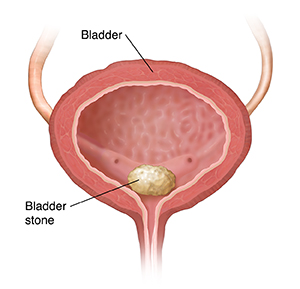
What causes bladder stones?
An enlarged prostate in men is the most common cause of bladder stones. The prostate is a small gland located near the urethra. The urethra is the tube that empties urine from the body. As men age, the prostate tends to become larger, and it pushes against the urethra. That may cause the bladder to not empty completely.
Other possible causes of bladder stones are:
-
Diet problems, such as a lack of water (dehydration).
-
Urinary tract infection.
-
Pelvic organ prolapse in women.
-
Injury to the spinal cord that affects how you urinate.
-
Bladder surgery.
-
Foreign object in the bladder, such as stitches from a medical procedure or a catheter.
Symptoms of bladder stones
Some bladder stones cause no problems. But if they do cause symptoms, these may include:
-
A sudden urge to urinate.
-
The need to urinate more often.
-
Being unable to hold your urine (incontinence).
-
Pain while urinating.
-
Blood in your urine.
-
Stomach pain.
Treatment for bladder stones
In some cases, you may not need any treatment for a bladder stone. It may eventually pass out of your body when you use the toilet. For larger stones, treatment may include:
-
Changes in diet. Drinking more water each day may help the stone leave your body. You may feel some pain when the stone passes. You may also need to cut back on salt and fat to stop more stones from forming.
-
Surgery. Several different procedures are available to treat bladder stones. Some stones may be removed through the urethra with a small tube with a camera on it (cystoscope). A health care provider may use the scope to break up the stone with lasers or shock waves. Large stones may be removed through a cut near the pelvis.
Possible complications of bladder stones
-
More bladder stones
-
Urinary tract infection
-
Damage to the bladder or urethra
-
Inability to urinate
When to call your doctor
Call your health care provider right away if you have any of these:
-
Fever of 100.4°F (38°C) or higher, or as directed by your provider
-
Redness, swelling, or fluid leaking from your incision that gets worse
-
Pain that gets worse
-
Blood in the urine
-
Can’t urinate
-
Symptoms that don’t get better, or get worse
-
New symptoms
Featured in
Author: Semko, Laura
Online Medical Reviewer: Callie Tayrien RN MSN
Online Medical Reviewer: Marc Greenstein MD
Online Medical Reviewer: Raymond Kent Turley BSN MSN RN
Date Last Reviewed: 04/01/2025
© 2000-2026 The StayWell Company, LLC. All rights reserved. This information is not intended as a substitute for professional medical care. Always follow your healthcare professional's instructions.