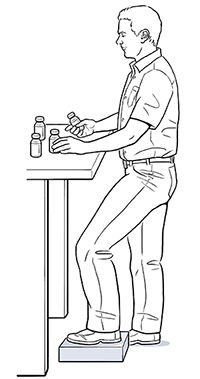
Having correct posture reduces strain on soft tissues. When you're in a neutral position, your bone structure supports you. A neutral position is a comfortable working posture in which your joints are naturally aligned. It provides a stable base to move from. As a result, your movements carry more power. And your muscles and tendons don't need to work harder just to keep you upright. Working in a neutral position also reduces the localized stress and strain experienced by the muscles, tendons, and joints involved in that particular task. This in turn reduces your risk of developing a musculoskeletal disorder (MSD). To stay close to the neutral position, try the tips below.
-
Assume a relaxed, tension-free posture. Use the right tools and setup for the job.
-
Face your work. If you need to change direction, move your whole body instead of twisting.
-
Position yourself so you don't have to stretch or slouch to reach your materials. You should be able to move your forearms straight out from your body to work.
-
Put a foot up on a ledge or stool to take pressure off your back.
-
Keep frequently used items close to prevent twisting or turning often.
-
Grasp with your whole hand instead of with just your fingers. Don't exert a lot of force while working.
-
Clear away clutter between you and your work.
-
Wait for items on an assembly line to reach you. Don't stretch to meet them.
-
Use task lighting so you don't have to lean over to see your work.
-
Use a magnifying device to protect both your eyes and your posture if you work with small items.
-
Tilt the angle of your work, not your head and neck.
-
Keep your wrists as straight as possible. Don't twist your wrists too far to either side or too far up or down.
-
When seated, keep your feet flat on the floor or support them with a footrest.
Online Medical Reviewer: Chris Southard RN
Online Medical Reviewer: Marianne Fraser MSN RN
Online Medical Reviewer: Vinita Wadhawan Researcher
Date Last Reviewed: 05/01/2024
© 2000-2026 The StayWell Company, LLC. All rights reserved. This information is not intended as a substitute for professional medical care. Always follow your healthcare professional's instructions.