Open surgery for kidney stones may be an option if:
-
The stone is very large.
-
You have a serious infection.
-
Other treatments have not worked.
-
There are changes in the structure of your kidneys or ureters.
-
You have high obesity.
Surgery may be done before, after, or instead of other treatments. If you need surgery, your health care provider will discuss its risks and possible complications. You will be told how to prepare. And you will be told about anesthesia that will keep you pain-free during treatment.
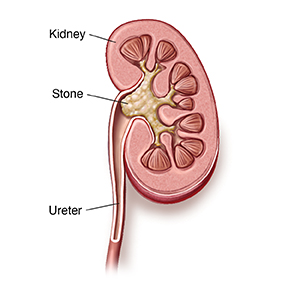
Open surgery
Open surgery removes very large stones or stones that can't be removed by other means. For this surgery, your provider makes an incision in your side. Your kidney or ureter is opened, and the stone is removed. Then your kidney or ureter is stitched closed. The skin incision is also stitched closed. A drain is left near the incision to carry urine away from the wound. In some cases, a temporary plastic tube called a stent is placed inside the ureter during the surgery. The stent helps the tissue heal and allows the urine to drain.
Your recovery
You may spend several days in the hospital. The drain in your incision will be removed before you leave. If you have a stent, it will be removed by your provider within 1 to 4 weeks. The stent may cause some discomfort while it is in place. You’ll need about 4 to 6 weeks of rest at home to recover fully. Follow-up visits and tests will help your provider spot any new stones early. This may help you avoid future surgeries.
When to contact your doctor
Contact your provider right away if:
-
You have sudden pain or flank pain that gets increasingly worse or is unbearable.
-
You have a fever over 100.4°F (38°C) or as directed by your provider.
-
You have nausea that lasts longer than indicated in your discharge instructions.
-
You have heavy bleeding when you urinate.
-
You have heavy bleeding through your drainage tube.
-
You have swelling or redness around your incision.
Call 911
Call
-
You are lightheaded or dizzy.
-
You have chest pain.
-
You are short of breath.
Featured in


