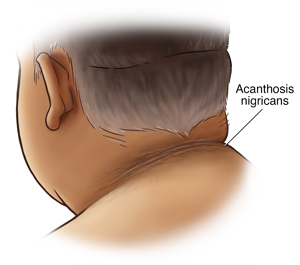
Acanthosis nigricans is a skin condition. It appears as dark, thick patches on the skin. These patches often occur in the folds or creases of the skin, such as on the neck. It is more common in people who are overweight or obese or who have a family history of the condition. Anyone can get this skin condition. But it is more common in people who are of American Indian, African American, Caribbean, or Hispanic descent.
How to say it
ak-an-THOH-sihs NI-grih-koonz
What causes acanthosis nigricans?
It isn’t always clear exactly what causes this skin problem. It may partly be genetic or linked to insulin resistance and diabetes. Many cases occur in people who have type 2 diabetes or who are obese and at high risk of developing type 2 diabetes.
In rare cases, it has been linked to some cancers, such as melanoma, liver, colon, and stomach. Some medicines may also cause it. These include birth control pills, niacin, and strong corticosteroids, such as prednisone. This condition may also be related to hormone disorders.
Symptoms of acanthosis nigricans
This skin condition can flare up anywhere on the body but most often is found on the neck, armpits, groin, elbows, and back of the knees. The skin may look dirty and dry at first. It then thickens and darkens. The patches are velvety in texture. They may range in color from brown to black. Thick areas may become moist and have an odor.
Treatment for acanthosis nigricans
This skin condition can be treated. Treatment choices include:
-
Managing the underlying health problem. Some cases of this skin condition will go away if you take care of the health problem that may be causing it. For example, if you are obese, your skin may improve if you lose some weight. People with diabetes may have clearer skin if they keep their blood sugar under control.
-
Using medicines for the skin (topical). Certain creams, lotions, or gels may help lighten up or dry out the skin.
-
Applying antibiotics to the skin and using antibacterial soaps.
-
Using retinoids in cream or pill form to help clear the skin.
In some cases, you may have laser therapy to thin or lighten the skin.
When to contact your doctor
Contact your doctor or get medical care right away if you have:
-
A fever of 100.4°F (38°C) or higher, or as directed by your doctor.
-
Pain that gets worse.
-
Symptoms that don’t get better, or get worse.
-
New symptoms.
Author: Semko, Laura
Online Medical Reviewer: L Renee Watson MSN RN
Online Medical Reviewer: Michael Lehrer MD
Online Medical Reviewer: Rita Sather RN
Date Last Reviewed: 06/01/2025
© 2000-2026 The StayWell Company, LLC. All rights reserved. This information is not intended as a substitute for professional medical care. Always follow your healthcare professional's instructions.

