What is jumper's knee?
Jumper's knee, also known as patellar tendonitis, is a condition characterized by inflammation of your patellar tendon (or patellar ligament). This connects your kneecap (patella) to your shinbone (tibia). Jumper's knee weakens your tendon, and, if untreated, can lead to tears in your tendon.
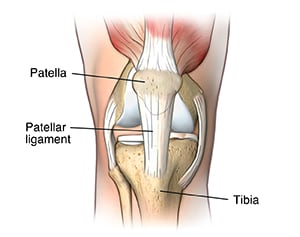
What causes jumper’s knee?
Jumper's knee is caused by overuse of your knee joint, such as frequent jumping on hard surfaces.
It's usually a sports-related injury. It is linked to leg muscle contraction and the force of hitting the ground. This strains your tendon. With repeated stress, your tendon may become inflamed.
What are the symptoms of jumper's knee?
Following are the most common symptoms of jumper's knee:
- Pain and soreness around your patellar tendon
- Pain with jumping, running, or walking
- Pain when bending or straightening your leg
- Tenderness below the lower part of your kneecap
The symptoms of jumper's knee may look like other conditions or medical problems. Always see your doctor for a diagnosis.
How is jumper's knee diagnosed?
In addition to a complete medical history and physical exam, your doctor may use an X-ray to help diagnose jumper's knee.
How is jumper's knee treated?
The best treatment for jumper's knee is to stop any activity that's causing the problem until the injury is healed. Other treatment may include:
- Nonsteroidal anti-inflammatory drugs (NSAIDs), such as ibuprofen or naproxen
- Rest
- Elevating your knee
- Ice packs to your knee to help reduce swelling
- Stretching and strengthening exercises
- Physical therapy
Key points about jumper's knee
- Jumper's knee is inflammation of your patellar tendon, the tendon that connects your kneecap (patella) to your shinbone (tibia).
- Jumper's knee is often a sports-related injury caused by overuse of your knee joint.
- You may need an X-ray to help diagnose jumper's knee.
- The best treatment for jumper's knee is to stop any activity that's causing the problem until the injury is healed.
Next steps
Tips to help you get the most from a visit to your doctor:
- Know the reason for your visit and what you want to happen.
- Write down questions you want answered before your visit.
- Bring someone with you to help you ask questions and remember what your doctor tells you.
- At the visit, write down the name of a new diagnosis, and any new medicines, treatments, or tests. Also write down any new instructions your doctor gives you.
- Know why a new medicine or treatment is prescribed, and how it will help you. Also know what the side effects are and when they should be reported.
- Ask if your condition can be treated in other ways.
- Know why a test or procedure is advised and what the results could mean.
- Know what to expect if you do not take the medicine or have the test or procedure.
- If you have a follow-up appointment, write down the date, time, and purpose for that visit.
- Know how you can contact your doctor if you have questions, especially after office hours and on weekends and holidays.
Online Medical Reviewer: Rahul Banerjee MD
Online Medical Reviewer: Raymond Turley Jr PA-C
Online Medical Reviewer: Rita Sather RN
Date Last Reviewed: 09/01/2023
© 2000-2026 The StayWell Company, LLC. All rights reserved. This information is not intended as a substitute for professional medical care. Always follow your healthcare professional's instructions.