Most trigger point injections are done in your health care provider's office. You may be told to stop taking certain medicines before the procedure. Tell your provider about any medicine allergies you have. Bring test results with you, as instructed.
During the procedure
You'll sit in a chair or lie on an exam table so your health care provider can reach the affected muscle.
-
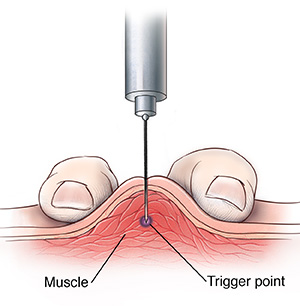
Your provider will feel and stretch the muscle to find the exact spot of the trigger point. This may hurt, but won't take long.
-
Once the trigger point is found, it's injected. The injection may contain medicine, such as a local anesthetic, which numbs the area. A steroid medicine may be added to the local anesthetic. Ask your provider what kind of medicine they'll use.
-
If you have other trigger points, the process is repeated.
After the treatment
You can go home soon after treatment. Take it easy for the rest of the day. The injection sites may be sore for a day or so. Put ice or heat on the treated sites as instructed by your health care provider. Ask what medicines are safe to take if you need pain relief. You can return to work the same day or the day after the treatment if your provider says it’s OK.
When to contact your doctor
Contact your health care provider right away if you have:
-
Increased pain.
-
Fever over
100.4 °F (38 °C), or as directed by your provider. -
Chills.
-
Drainage at the treated site.
Call 911
Call 911 if you have chest pain or trouble breathing, especially if the injection was done in the neck, chest, upper belly, or middle to upper back.
Author: adas
Author: De'Vette
Online Medical Reviewer: Marianne Fraser MSN RN
Online Medical Reviewer: Michelle Johnson BSN RN AMB-BC
Online Medical Reviewer: Rita Sather RN
© 2000-2026 The StayWell Company, LLC. All rights reserved. This information is not intended as a substitute for professional medical care. Always follow your healthcare professional's instructions.