Nonstress tests and contraction stress tests (CST) are simple ways to check the well-being of your baby. The tests let your healthcare provider know if it's best to deliver your baby right away, or to wait.
Questions
Talk with your healthcare provider if you have questions about these procedures.
What to expect during your test
-
The tests are done at your healthcare provider's office or in the hospital. You lie down on your back or side in bed. Or you recline in a chair.
-
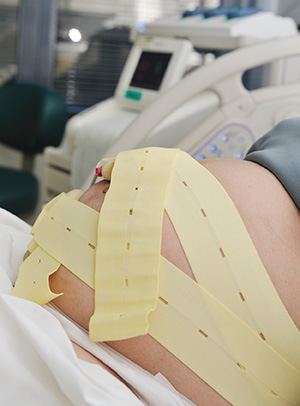
A fetal heart monitor is placed around your stomach. It's placed in the area where the baby’s heartbeat is the loudest. It's held in place by a belt or strap.
-
Another device is placed on your stomach. It measures contractions of your uterus. It's held in place by a second belt or strap.
Nonstress test
A nonstress test lets your healthcare provider keep track of your baby’s heartbeat. If the heartbeat increases normally during the test, it means that your baby is likely getting enough oxygen and nutrients from your blood.
Contraction stress test (CST)
A CST tells your healthcare provider if your baby’s heartbeat is reacting normally during mild, labor-like contractions. This gives a preview of how well your baby will handle the stress of labor.
During CST
To set off mild contractions in your uterus, your healthcare provider will give you an IV (intravenous) medicine. Oxytocin is almost always used.
Featured in
Online Medical Reviewer: Daniel N Sacks MD
Online Medical Reviewer: Donna Freeborn PhD CNM FNP
Online Medical Reviewer: Heather Trevino
Date Last Reviewed: 09/01/2025
© 2000-2026 The StayWell Company, LLC. All rights reserved. This information is not intended as a substitute for professional medical care. Always follow your healthcare professional's instructions.