Definition

Depression and the Brain’s Chemical Balance

Choose a preferred language

Everyone feels sad from time to time. But depression is much more than just feeling down. It's a real illness just like diabetes or heart disease. You can't just "snap out of it." Experts think that more than one thing causes depression. These include genes, biology, environment, and mental health. And chemical changes in the brain may add to the symptoms.


Brain chemicals and depression

The brain is a complex organ. It controls your whole body. This includes your emotions, too. It does this by sending messages from one nerve cell to another. Messages also travel inside the brain. They travel with help from chemicals. These are called neurotransmitters. No one knows exactly what happens in the brain to cause depression. But experts know that neurotransmitters are involved.
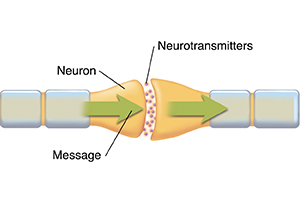
Closeup of synapse showing neurotransmitters between healthy neurons. Arrows show message moving along neurons.


Changes in the brain

Two neurotransmitters are mainly involved in depression. These are norepinephrine and serotonin. Medicines and talk therapy are the main treatments for depression. Both change the levels of these chemicals. In many cases, they ease symptoms of depression.

Online Medical Reviewer: Daphne Pierce-Smith RN MSN

Online Medical Reviewer: Marianne Fraser MSN RN

Online Medical Reviewer: Sravani Chintapalli Researcher

Date Last Reviewed: 06/01/2025

© 2000-2026 The StayWell Company, LLC. All rights reserved. This information is not intended as a substitute for professional medical care. Always follow your healthcare professional's instructions.


Behavioral Health Services

Lead a balanced and fulfilling life with our behavioral health services.

Call our Behavioral Health line toll‑free at 1‑855‑877‑3885 (TTY 711), available 24 hours a day, 7 days a week

View available services

Get Care Now

Your health is everything to us. Please reach out for support if you need it.

Get Care Now
Related Articles
Read article
Mental Health
Overview of Mood Disorders

A mood disorder is a mental health class. The term is used to broadly describe all types of depression and bipolar disorders.

Read article
Mental Health
Panic Attack

A panic attack is an extreme fear reaction that comes on for no clear reason. The attack may last a few minutes up to a few hours. Between attacks, things will seem quite normal.

Read article
Mental Health
Coping With PTSD

You may think that asking for help is a sign of weakness. In fact, taking action to make your life better takes a lot of courage. Talking about a trauma can be hard, but it can make a big difference.

Read article
Mental Health
Functional Neurological Symptom Disorder (Conversion Disorder)

Functional neurological symptoms disorder happens when stress or conflict set off physical symptoms. The symptoms may resemble those of a neurological disorder.