Age-related macular degeneration (AMD) is an eye disease. It affects the central part of the retina called the macula. This is the part of the eye that controls your central, detailed vision. AMD is the leading cause of vision loss in adults over age 50. It almost always affects both eyes. The macula becomes damaged. Central vision becomes limited. But side (peripheral) vision stays clear. There are 2 types of AMD: dry and wet.
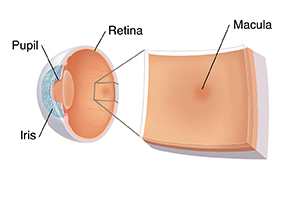
Dry AMD
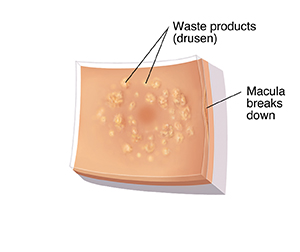
Dry is the most common type of AMD. In the early stages, changes in vision may be hard to notice. Over time, your central vision may slowly worsen. You may see wavy lines and blank spots in the center of your vision. Colors may look dim. There is no way to restore vision lost from dry AMD. But it's important to closely watch the condition. It can progress into wet AMD.
Some people with dry AMD develop geographic atrophy (GA). This is an advanced form of dry AMD. Cells die in certain areas of the retina. This can cause blind spots, often in the center of your vision. If a person has GA in one eye, it's more likely to develop in the other eye. Medicines are available to slow the progression of GA. They are given as injections into the eye.
Wet AMD
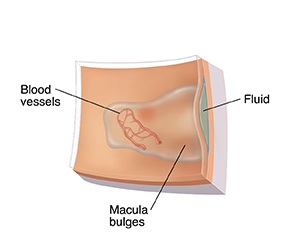
Wet AMD is less common but more serious. Vision loss may be faster and more noticeable. You may suddenly see dark spots, blank spots, wavy lines, and dim colors in the center of your vision. It's important to find wet AMD early. Then certain treatments may help to slow further vision loss or even improve vision. These treatments include injections, photodynamic therapy, and laser surgery.
Online Medical Reviewer: Chris Haupert MD
Online Medical Reviewer: Tara Novick BSN MSN
Online Medical Reviewer: Whitney Seltman MD
Date Last Reviewed: 09/01/2025
© 2000-2026 The StayWell Company, LLC. All rights reserved. This information is not intended as a substitute for professional medical care. Always follow your healthcare professional's instructions.