Dismiss Modal

Definition

Entérese de cómo escucha

Choose a preferred language

El sonido se desplaza por el aire como las ondas que se producen al arrojar una piedra en una laguna. Sus oídos pueden recoger estas ondas sonoras que lo rodean y enviarlas al cerebro. A continuación se describe cómo las distintas partes de su oído funcionan para ayudarlo a escuchar.


Tres partes del oído

El oído está compuesto por los siguientes elementos: 

  • El oído externo recoge las ondas sonoras.

  • Las ondas sonoras entran al oído y tocan el tímpano en el oído medio. Tres huesos minúsculos del oído medio comienzan a moverse.

  • Esto transfiere las ondas sonoras al oído interno, que está lleno de líquido. Allí, miles de células ciliadas convierten las ondas sonoras en impulsos nerviosos. Estos impulsos viajan por los nervios hacia el cerebro. Al llegar al cerebro, usted percibe el sonido.
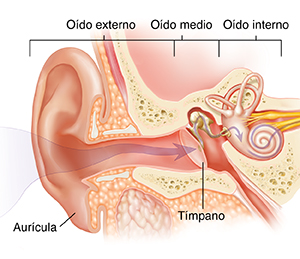
    Corte transversal del oído donde pueden verse las estructuras del oído externo, interno y medio.


Las células ciliadas dañadas afectan la audición

Las células ciliadas se mueven cuando el sonido entrante hace vibrar el líquido del oído interno. Este movimiento se convierte en impulsos que le permiten escuchar el sonido.

Los ruidos fuertes hacen que las células ciliadas se muevan demasiado y pueden dañarlas. Las células ciliadas aplanadas no pueden enviar completamente los impulsos nerviosos al cerebro. Una vez que se dañan, nunca se recuperan.
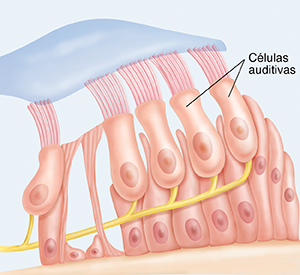

Células ciliadas en la cóclea.

© 2000-2025 The StayWell Company, LLC. Todos los derechos reservados. Esta información no pretende sustituir la atención médica profesional. Sólo su médico puede diagnosticar y tratar un problema de salud.

Find the right providers for your needs.

CalOptima Health works with thousands of Orange County providers, including doctors, specialists, health networks, medical groups and more.

Find a Doctor

Get Care Now

Your health is everything to us. Please reach out for support if you need it.

Get Care Now
Related Articles
Read article
Ear, Nose, and Throat
Anatomy and Physiology of the Ear

The main parts of the ear are the outer ear, the eardrum (tympanic membrane), the middle ear, and the inner ear.

Read article
Ear, Nose, and Throat
Common Middle Ear Problems

Your middle ear may have been injured or infected recently. Over time, certain growths or bone disease can also harm the middle ear. Left untreated, these problems often lead to lifelong hearing loss. Read on to learn more.

Read article
Ear, Nose, and Throat
Ménière Disease

Ménière disease is a balance disorder. It causes a severe spinning sensation (vertigo), hearing issues, loss of balance, and headaches.

Read article
Ear, Nose, and Throat
The Middle Ear

The middle ear is an air-filled chamber that lies behind the eardrum. Pressure in the middle ear changes to match air pressure outside of the eardrum. When inside and outside pressures are balanced, the eardrum is flexible and normal hearing is more likely. Problems happen when air pressure in the middle ear drops. This is often due to a block in the eustachian (u-STA-shun) tube, the narrow channel connecting the ear with the back of the throat.