Dismiss Modal

Definition

How You Hear

Choose a preferred language

Sound moves through the air like the ripples you see after throwing a stone into a pond. Your ears collect these waves of sound around you and send them to your brain. This is how the parts of your ear work so you can hear.


Three parts of your ear

Your ear is made up of the following parts: 

  • Your outer ear collects sound waves.

  • Sound waves enter the ear and hit the eardrum in your middle ear. Three tiny bones in the middle ear are set into motion.

  • This transfers sound waves to the fluid-filled inner ear. There, thousands of hair cells turn sound waves into nerve impulses. These impulses travel along nerves to your brain. When the impulses reach your brain, you perceive sound.
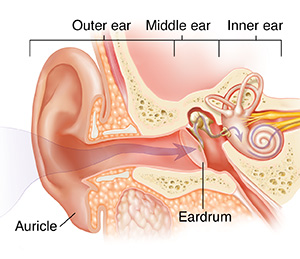
Cross section of ear showing outer, inner, and middle ear structures.


Damaged hair cells affect hearing

Hair cells move when incoming sound vibrates the inner ear fluid. The motion is turned into impulses that let you hear the sound.

Loud noise causes hair cells to move too much and can damage them. Flattened hair cells can't fully send nerve impulses to your brain. Once damaged, hair cells never recover.
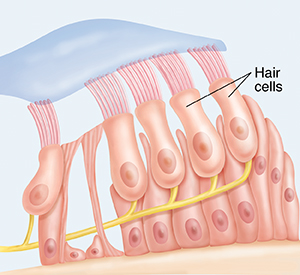

Hair cells in the cochlea.

© 2000-2025 The StayWell Company, LLC. All rights reserved. This information is not intended as a substitute for professional medical care. Always follow your healthcare professional's instructions.

Find the right providers for your needs.

CalOptima Health works with thousands of Orange County providers, including doctors, specialists, health networks, medical groups and more.

Find a Doctor

Get Care Now

Your health is everything to us. Please reach out for support if you need it.

Get Care Now
Related Articles
Read article
Ear, Nose, and Throat
Understanding Hearing Loss

As you age, some hearing loss is normal. You lose more than the ability to hear how loud a sound is. You also lose the ability to hear certain types of sounds. For example, you might not be able to hear some of the high-pitched sounds of a child's voice.

Read article
Ear, Nose, and Throat
Sinusitis

Sinusitis is an infection of the lining of the sinuses near the nose. These infections most often happen after a cold or after an allergy flare-up.

Read article
Ear, Nose, and Throat
Spasmodic Dysphonia

Spasmodic dysphonia is a voice disorder. It causes involuntary spasms in the muscles of the voice box or larynx. This causes the voice to break and have a tight, strained, or strangled sound. Read on to learn more, including causes, symptoms, and treatment.

Read article
Ear, Nose, and Throat
Styles of Hearing Aids

Your audiologist or hearing aid specialist will work with you to make the best all-around choice. This choice should reflect your needs, preferences, and budget.
