Rectal bleeding is when blood passes through your rectum and anus. It can happen with or without a bowel movement. Rectal bleeding may be a sign of a serious problem in your rectum, colon, or upper GI tract. Call your health care provider right away if you have any rectal bleeding.
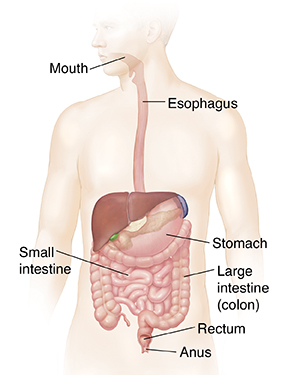
The GI tract
The gastrointestinal (GI) tract includes the:
-
Mouth.
-
Esophagus.
-
Stomach.
-
Small intestine.
-
Large intestine (colon).
-
Rectum.
-
Anus.
The food you eat is digested as it passes through the GI tract. Solid waste leaves the body through the rectum and anus.
Rectal bleeding and GI problems
The cause of rectal bleeding may be found in any part of the GI tract. The colon or rectum may be the site of your bleeding problem. Or bleeding may be due to problems farther up the GI tract, such as in the small intestine, duodenum, or stomach.
Causes of rectal bleeding
Possible causes include:
-
Swollen veins in the rectum and anus (hemorrhoids).
-
Tears in or near the anus (fissures).
-
Pockets in the colon wall that can bleed (diverticulosis).
-
Infection.
-
Low blood flow (ischemia).
-
Radiation damage.
-
Inflammatory bowel disease (Crohn's disease or ulcerative colitis).
-
Ulcers in the upper GI tract and inflammation of the large intestine.
-
Abnormal tissue growths (cancer tumors or polyps) in the GI tract.
-
A bulging rectum (rectal prolapse).
-
Abnormal blood vessels in the small intestine or in the colon.
Common symptoms
Common symptoms are:
-
Rectal pain, itching, or soreness.
-
Belly pain, including upper belly pain near the stomach (epigastric pain).
-
Small drops of blood that sometimes are seen on the stool or toilet paper.
-
Stool that looks red, black, or tarry.
Rectal bleeding can also happen without pain.
Online Medical Reviewer: Jen Lehrer MD
Online Medical Reviewer: Rita Sather RN
Online Medical Reviewer: Robyn Zercher FNP
Date Last Reviewed: 01/01/2025
© 2000-2026 The StayWell Company, LLC. All rights reserved. This information is not intended as a substitute for professional medical care. Always follow your healthcare professional's instructions.