The digestive system breaks food down into basic nutrients that can be used by the body. As food moves through the digestive tract, it’s digested (broken down into parts and absorbed into the bloodstream). Certain organs, such as the liver, gallbladder, and pancreas, help with this digestion. Parts of food that can’t be digested become stool. This is waste material that’s passed out of the body.
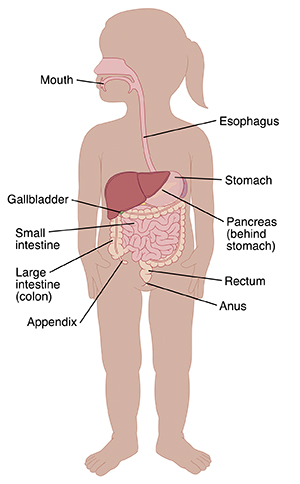
Digestive system
-
The mouth takes in food and breaks it into pieces. It starts the process of digestion.
-
The esophagus moves food from the mouth to the stomach.
-
The stomach breaks food down into a liquid mixture.
-
The small intestine digests food further and absorbs nutrients. What’s left is passed on to the colon as liquid waste.
-
The large intestine (colon) absorbs water, salt, and other minerals from liquid waste, forming a solid stool.
-
The rectum stores stool until a bowel movement occurs.
-
The anus is the opening where stool leaves the body.
-
The liver makes bile (a fluid that helps digest fat). It also breaks down nutrients and stores energy.
-
The gallbladder stores bile.
-
The pancreas makes enzymes that help with digestion.
-
The appendix is a small, hollow structure that’s attached to the large intestine. It has no clear function in the body. But it can become blocked and infected.
Featured in
Online Medical Reviewer: Amy Finke RN BSN
Online Medical Reviewer: L Renee Watson MSN RN
Online Medical Reviewer: Liora C Adler MD
Date Last Reviewed: 12/01/2024
© 2000-2026 The StayWell Company, LLC. All rights reserved. This information is not intended as a substitute for professional medical care. Always follow your healthcare professional's instructions.