Definition

Anatomy of the Anus

Choose a preferred language

The anus is the last part of the digestive tract. It's at the end of the rectum. It's where stool comes out of the body. It consists of a muscular ring (called a sphincter) that opens during a bowel movement to allow stool (feces) to pass through and flat cells that line the inside of the anus. Most anal cancers start in these flat lining cells. These are also called squamous cells. The lower part of the anus, where it meets the skin, is called the anal margin.
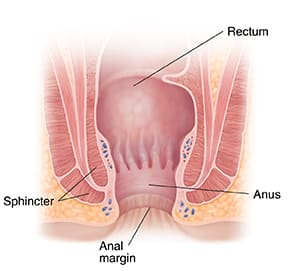
Cross section of end of digestive system, showing rectum, anus, sphincter, and anal margin.

© 2026 The StayWell Company, LLC. All rights reserved. This information is not intended as a substitute for professional medical care. Always follow your healthcare provider's instructions.


Find the right providers for your needs.

CalOptima Health works with thousands of Orange County providers, including doctors, specialists, health networks, medical groups and more.

Find a Doctor

Get Care Now

Your health is everything to us. Please reach out for support if you need it.

Get Care Now
Related Articles
Read article
Digestive Health
The Digestive Process: Digestion Begins in the Mouth

Digestion is a multistep process that begins the moment you place a piece of food in your mouth or sip some juice.

Read article
Digestive Health
What Is a Hiatal Hernia?

This common problem occurs when part of the stomach slides up through the diaphragm into the chest cavity. Hiatal hernias aren't like hernias in your groin. Most hiatal hernias cause no symptoms and need no treatment. If you notice symptoms, usually you can control them easily.

Read article
Metabolic Conditions
Abdominal Ultrasound

Abdominal ultrasound is an imaging test that uses sound waves to form pictures of your abdominal organs. It can help detect organ problems, such as gallstones, kidney stones, or liver disease.

Read article
Digestive Health
Discharge Instructions: Your Nasogastric Tube (NG Tube)

The NG tube will give you food, fluids, and medicine. Read on for helpful information about when to call your provider.