Breasts come in all shapes and sizes. But they all share the same features. You can learn about the parts (anatomy) of your breasts. This will help you know what you're seeing and feeling. Then you can learn what's normal for your breasts.
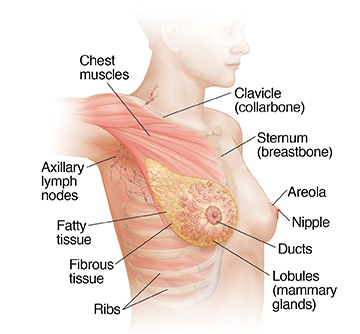
Areola. A dark circle of skin that surrounds the nipple.
Nipple. Where milk comes out during breastfeeding.
Fibrous tissue. This tissue supports your breasts, making them feel firm.
Lobules (mammary glands). They produce milk during pregnancy and breastfeeding.
Ducts. Tubes that carry milk from the lobules during breastfeeding.
Fatty tissue. This fills the spaces around the ducts and lobules.
Axillary lymph nodes. These filter lymph fluid from your breast and help your body fight infection.
Ribs. These bones can be felt beneath the skin.
Clavicle (collarbone). This marks the upper boundary of the breast tissue.
Sternum (breastbone). This can be felt beneath the skin.
Chest muscles. These help move your arm.
Featured in
Online Medical Reviewer: Daniel N Sacks MD
Online Medical Reviewer: Donna Freeborn PhD CNM FNP
Online Medical Reviewer: Louise Cunningham RN BSN
Date Last Reviewed: 05/01/2025
© 2000-2026 The StayWell Company, LLC. All rights reserved. This information is not intended as a substitute for professional medical care. Always follow your healthcare professional's instructions.