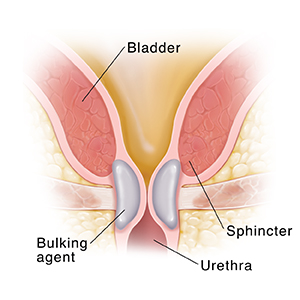
If you have trouble holding your urine, it may be because of a weak muscle around the urethra. This muscle is called a sphincter. Urethral implants are a way to help treat stress incontinence caused by a weak sphincter. A urethral implant is also called a bulking agent. A bulking agent is injected (implanted) into the walls of your urethra. This may help close the sphincter. It can help restore most or all of your control over urine flow. There are different kinds of bulking agents. Ask your healthcare provider about the pros and cons of the bulking agent that will be used.
This procedure is often done in the hospital. You won't need any cuts (incisions) or stitches. You will likely go home the same day. You may not get complete relief from incontinence with the procedure. But most people have less leakage.
Your experience
-
Before the procedure, you will be asked to sign an informed consent form. Read the entire document carefully. Have all of your questions answered before signing it.
-
You will be given medicine (anesthesia) to keep you pain-free. You may have one or more of these:
-
Local anesthesia. This numbs your urethra and bladder.
-
Regional anesthesia. This numbs your body below the waist.
-
General anesthesia. This allows you to sleep comfortably during the entire procedure.
-
-
The healthcare provider puts a thin tube with a camera (cystoscope) into your urethra. This tool lets them see the inside of your urethra.
-
The provider puts a needle into the sphincter area. This may be done through the cystoscope. Or it may be done along the outside of your urethra.
-
The provider injects a bulking agent through this needle into the urethra wall. This makes the wall of the urethra thicker. It then closes up. This stops urine from leaking out of the bladder. The wall moves apart when you try to pee. This lets urine flow.
-
Urethral implants work well in 3 in 5 to 7 in 10 people. The procedure is not a permanent cure. This is because it wears off over time. Most people need another injection within 6 to 24 months.
Possible complications (rare)
-
Incontinence gets worse in short term or long term
-
Infection of the bladder or urethra. This can cause a pocket of pus to form.
-
Pain or discomfort at the injection site
-
Inability to pee (urinary retention). People with this problem will need to use a self-catheter..
-
Allergic reaction to bulking agent
-
Shifting of the bulking agent near the site of the injection
-
Complications of anesthesia
When to call your healthcare provider
Call your healthcare provider if you have any of the following after the procedure:
-
Bleeding heavily
-
Bright red pee or large blood clots in the pee. Small amounts of blood are a normal and temporary.
-
Trouble peeing. Or a sense your bladder is not emptying fully.
-
Signs of infection, such as:
-
Fever over
100.4 ° F (38 °C ) or higher, or as directed by your provider -
Chills
-
Need to pee more often
-
Very strong urge to pee
-
Burning when peeing or changes to color or smell of the pee
-