Dismiss Modal

Treatment

PD Catheter Access: Placing the Catheter

Choose a preferred language

Your kidneys filter and remove waste from your blood. When they fail, this work must be done some other way. Peritoneal dialysis (PD) is a treatment that can take over when your kidneys stop working. The peritoneum is the membrane lining the inside of your abdomen (belly). PD uses the lining of your abdomen as a filter for your blood. Before PD can be done, an opening into this lining (an access) must be made. The access for PD is a soft tube called a catheter placed into your abdomen.
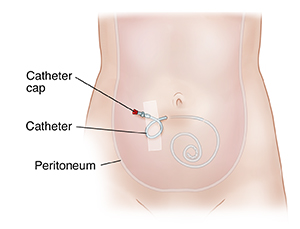
Front view of abdomen showing peritoneal dialysis catheter in place.


Placing the catheter

  • A nurse or anesthesiologist gives you medicine so you don’t feel pain during surgery.

  • A small opening is made just below your belly button (navel). The catheter is placed through this opening.

  • One end of the catheter sits in your abdomen. A few inches of the other end comes out an exit site in your skin. This end is clamped off and capped when it’s not being used.

  • Typically, a part of the catheter goes through a tunnel made underneath the skin before it enters your abdomen. This tunnel helps prevent infections from entering your abdomen. It also holds the catheter in place to keep it from falling out.


© 2000-2025 The StayWell Company, LLC. All rights reserved. This information is not intended as a substitute for professional medical care. Always follow your healthcare professional's instructions.

Find the right providers for your needs.

CalOptima Health works with thousands of Orange County providers, including doctors, specialists, health networks, medical groups and more.

Find a Doctor

Get Care Now

Your health is everything to us. Please reach out for support if you need it.

Get Care Now
Related Articles
Read article
Urology
Percutaneous Nephrostomy

Percutaneous nephrostomy is a procedure where a small tube (catheter) is put through your skin into your kidney to drain your urine. This procedure is done by a specially trained healthcare provider called an interventional radiologist.

Read article
Heart Health
Hemodialysis Discharge

Hemodialysis is a treatment that takes over the essential functions of the kidney until you recover from the kidney disease, or obtain a kidney transplant. If you have end stage renal disease and are not eligible for a transplant, you will need to have hemodialysis for the rest of your life.

Read article
Urology
Renal (Kidney) Insufficiency

When your kidneys don't work as they should, waste products build up in your blood. The early stage of this process is called renal insufficiency. If renal insufficiency gets worse, you can develop chronic renal failure.

Read article
Heart Health
Hemodialysis Access Bleeding

You have a hemodialysis access in your arm, either an arteriovenous (AV) fistula or an artery to vein graft. It has been bleeding. Blood needs to flow freely through the fistula or graft. As part of your treatment, you are also taking medication that thins your blood. This makes you bleed more easily. It is important to stop your fistula or graft from bleeding as soon as possible.