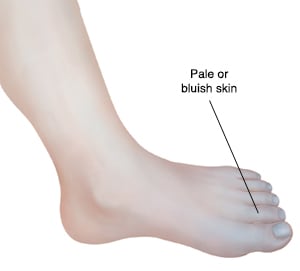
Acute arterial occlusion is serious. It occurs when blood flow in a leg artery stops suddenly. If blood flow to your toe, foot, or leg is completely blocked, the tissue starts to die. This is called gangrene. If this happens, medical care is needed right away to restore blood flow and possibly save your leg.
When do you need emergency care?
Contact your doctor or go to the emergency department right away if you have any of the following:
- Sudden pain in your leg or foot that may become severe
- Pale or blue skin
- Skin feels cold to the touch
- Pins and needles feeling or numbness
- No pulse where you used to be able to feel one
Call
Causes of acute arterial occlusion
You are more likely to have this condition if you have peripheral arterial disease (PAD). With PAD, leg arteries are narrowed. This reduces blood flow to your legs and feet.
How is acute arterial occlusion diagnosed?
First, a doctor carefully gives you an exam. They check your pulse in several different spots. Then tests are done to check your blood flow. These tests may include:
- Ankle-brachial index (ABI). The blood pressure in your ankle is compared to the blood pressure in your arm.
- Duplex ultrasound. Harmless sound waves are used to create images of blood flow in your legs.
- Arteriography. X-ray dye (contrast medium) is injected into the artery. This is done using a thin, flexible tube (catheter). The dye makes blood vessels show up more clearly on X-rays.
How is acute arterial occlusion treated?
Possible treatments for acute arterial occlusion include:
- Dissolving or removing a blood clot. A tube (catheter) may be put into an artery in the groin. Clot-busting medicine is then put into the tube to dissolve the clot. Or surgery may be done to remove the clot. A cut (incision) is made in the artery at the blocked area. The clot is then removed.
- Angioplasty. A tiny, uninflated balloon is passed through a catheter to the narrowed part of the artery. The balloon is inflated to widen the artery. The balloon is then deflated and removed.
- Stenting. After angioplasty, a tiny wire mesh tube (stent) may be put in the artery to help hold it open. The stent is also placed using a catheter.
- Endarterectomy. An incision is made in the artery at the blocked area. The material that blocks the artery is then removed from artery walls.
- Peripheral bypass surgery. A natural or manmade graft is used to bypass the blocked part of the artery.
How can I protect myself?
Know the signs and symptoms of an acute arterial occlusion. If you have diabetes or poor blood circulation, check your feet daily for wounds, sores, blisters, and color changes. Contact your doctor right away if you notice problems. If you smoke, get help to stop.


