You've been discharged with a Hemovac drainage tube. The tube was placed in your incision to remove fluid and is attached to a drain or collection device. It will help healing and reduce the risk of infection. Expect to see fluid and blood in the drain. You may also feel some burning and pulling from the stitch that holds the tube in place. Your drain is usually removed when the fluid leaking from it is less than 2 tablespoons each day. There is a bandage at the site where the tube is placed. This is to protect the open area from infection. Your stitches will be taken out 7 to 14 days after surgery. Here's what you need to do to care for your Hemovac drainage tube.
General guidelines
-
Don’t sleep on the same side as the tube.
-
Secure the tube and bag inside your clothing. This will prevent the tube from being pulled out.
-
Take a sponge bath to prevent getting your bandage and tube site wet, unless your healthcare provider tells you otherwise.
-
Ask your provider when you can take a shower or bathe.
-
Ask your provider about the best way to keep the site dry when bathing or showering.
Empty the drain
Empty your drain at least twice a day. Empty it more often if needed.
-
Wash your hands with plain soap and clean, running water for at least 20 seconds. If someone is helping you, have that person wear clean, non-sterile gloves after washing their hands.
-
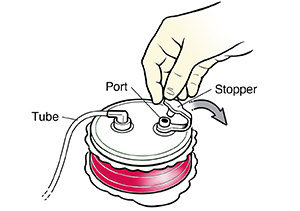
Lift the stopper. Don't touch the open port. The drain will expand.
-
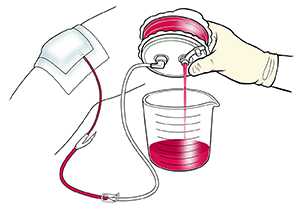
Turn the drain upside down.
-
Drain the fluid into a measuring cup.
-
Record the amount of fluid each time you empty the drain. Total the amount daily. Share this information with your healthcare provider at your next visit.
-
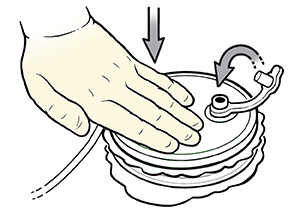
Place the empty drain on a hard surface and press down until it's flat.
-
Close the cork-stopper device.
-
Wash your hands again.
Change the dressing
Change the dressing around the tube every day.
-
Wash your hands with plain soap and clean, running water for at least 20 seconds.
-
Remove the old bandage.
-
Wash your hands again.
-
Wet a cotton swab and clean around the incision and tube site. Use normal saline solution (salt and water).
-
Put a new bandage on the incision and tube site. Make the bandage large enough to cover the whole incision area.
-
Tape the bandage in place.
-
Wash your hands again.
Follow-up
Make a follow-up appointment as directed.
When to call your healthcare provider
Call your provider right away if you have any of these:
-
Pain, swelling, or fluid around the tube
-
Redness or warmth around the incision or fluid draining from the incision
-
Nausea and vomiting
-
Fever above 100.4 °F (38 °C) or higher, or as advised by your provider
-
Chills
-
An incision that does not heal or stitches that become infected or loose
-
A tube that falls out. Tell your provider right away.
-
A foul smell from the incision site
-
Drainage that changes from light pink to dark red
-
An increase in the amount of drainage after an initial decrease