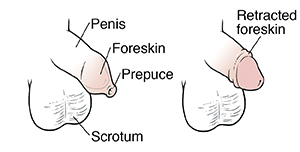
An uncircumcised penis still has the foreskin attached. Caring for your newborn’s penis is fairly easy. Keep in mind the following:
-
When bathing your child, wash the penis. Then dry it thoroughly.
-
Never forcibly pull back (retract) the foreskin when washing your infant or young child. Forcing the foreskin to retract can cause severe pain, bleeding, tears in the skin, and scarring. The foreskin will likely be able to retract by the time your child is 3 years old. It may take a few weeks, months, or years, but it depends on the child.
-
When the foreskin separates from the head of the penis, skin cells are shed. These skin cells may look like white, pearl-like lumps under the foreskin. These are called smegma. Smegma is normal and nothing to worry about.
-
When the foreskin is able to retract, gently pull it back and bathe the area with a very mild soap and water. Pat dry the penis thoroughly.
-
Return the foreskin to its natural position by pulling it back over the penis. This is important. If the foreskin is left retracted, it could put pressure on the penis. This can cause pain and swelling and may require medical attention.
-
When the child is old enough, teach him to retract the foreskin to clean his penis. Tell him to return the foreskin to its natural position after drying the penis.
-
Be sure that you (or your child) wash your hands before touching the penis. This is especially important if you have been handling anything that might irritate the penis, such as chemicals, chili peppers, or heat rub.
When to call your doctor
Contact your child’s doctor if your child’s penis has:
-
Foreskin that is stuck in the retracted position. This needs to be treated right away.
-
Redness.
-
Swelling.
-
A foul odor.
-
Pain.
-
Irregular buildup or discharge.
-
An abnormal urine stream, such as going off to one side or dribbling.
Featured in