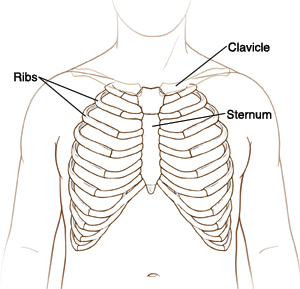
You broke 1 or more ribs. This is called a rib fracture. Rib fractures don't need a cast like other bones. Healing time is different for each person. Most rib fractures take weeks to months. The first 3 to 4 weeks will be the most painful. During this time deep breathing, coughing, or changing position from sitting to lying down, may cause the broken ends to move slightly.
Home care
-
Rest. Don't do any heavy lifting or strenuous exertion until the pain goes away.
-
It hurts to breathe when you have a broken rib. This puts you at risk of getting pneumonia from poor airflow through your lungs. To prevent this:
-
Take 10 to 15 deep breaths at least 4 times a day, or as directed. Breathe out through pursed lips as if you are blowing up a balloon. If possible, actually blow up a balloon or a rubber glove. This exercise builds up pressure inside the lung and prevents collapse of the small air sacs of the lung. This exercise may cause some pain at the site of injury. This is normal.
-
You may have gotten a breathing exercise device called an incentive spirometer. Use it at least 4 times a day, or as directed.
-
Holding a pillow or similar soft brace against the fracture site can help reduce your discomfort while using the spirometer or when coughing or sneezing.
-
-
Apply an ice pack over the injured area for 15 to 20 minutes every 1 to 2 hours. Do this for the first 24 to 48 hours. To make an ice pack, put ice cubes in a plastic bag that seals at the top. Wrap the bag in a clean, thin towel or cloth. Never put ice or an ice pack directly on your skin. Keep using ice packs as needed to ease pain and swelling.
-
You may use over-the-counter pain medicine to control pain, unless another pain medicine was prescribed. If you have chronic liver or kidney disease or ever had a stomach ulcer, gastrointestinal bleeding, or take a blood thinner, talk with your healthcare provider before using these medicines.
-
If your pain is not controlled, contact your provider. Sometimes a stronger pain medicine may be needed. A nerve block can be done in case of severe pain. It will numb the nerve between the ribs.
-
Follow your healthcare provider's instructions on returning to normal activities.
Follow-up care
Follow up with your healthcare provider as advised. In rare cases, a broken rib will cause complications in the first few days that may not be clearly seen during your initial exam. This can include collapsed lung, bleeding around the lung or into the belly (abdomen), or pneumonia. So watch for the signs below.
If X-rays were taken, you will be told of any new findings that may affect your care.
Call 911
Call
-
Dizziness, weakness or fainting
-
Shortness of breath with or without chest discomfort
-
Cough, coughing up blood, or abdominal pain that is new or gets worse.
-
Chest pain
-
Discomfort in other areas of your upper body, such as your shoulders, jaw, neck, or arms.
When to get medical advice
Call your healthcare provider right away if any of these occur:
-
Increasing chest pain with breathing
-
Fever of 100.4°F (38°C) or above, or as directed by your provider
-
Chills
-
Congested cough, nausea, or vomiting
-
Difficulty with routine activities, such as dressing, taking a shower, and climbing stairs.
-
Pain that is not helped by your medicines.