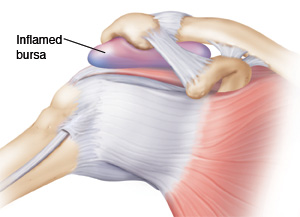
You have bursitis. This is an inflammation of the bursa. These are small, fluid-filled sacs that surround the larger joints of the body. The bursa help the muscles and tendons move smoothly over the joints.
Bursitis often happens in the shoulder. But it can also affect the elbows, hips, pelvis, knees, toes, and heels. Bursitis can be caused by injury, overuse of the joint, or infection of the bursa. Symptoms include pain and tenderness over a joint. Symptoms get worse with movement.
Bursitis is treated with an anti-inflammatory medicine and by resting the joint. More severe cases need an injection of medicine directly into the bursa. In the case of infection, surgery and antibiotics may be needed.
Home care
-
Rest the painful joint and protect it from movement. This will allow the inflammation to heal faster.
-
Apply an ice pack over the injured area for no more than 15 to 20 minutes. Do this every 3 to 6 hours for the first 24 to 48 hours. Keep using ice packs 3 to 4 times a day until the pain and swelling improves.
-
To make an ice pack, put ice cubes in a sealed plastic bag. Wrap the bag in a clean, thin towel or cloth. Never put ice or an ice pack directly on the skin. As the ice melts, be careful to not to get the wrap or splint wet.
-
You may take over-the-counter pain medicine to treat pain and inflammation, unless another medicine was prescribed. Anti-inflammatory pain medicines may be more effective. Talk with your health care provider before using these medicines if you have chronic liver or kidney disease, ever had a stomach ulcer or gastrointestinal, or take blood thinners.
-
As your symptoms improve, slowly begin to move the joint. Don't overuse the joint. This may cause the symptoms to flare up again.
When to get medical advice
Contact your health care provider right away if any of these occur:
-
Redness or warmth over the painful area
-
Increasing pain or swelling at the joint
-
Fever of 100.4°F (38°C) or above lasting for 24 to 48 hours, or as advised
-
Chills


