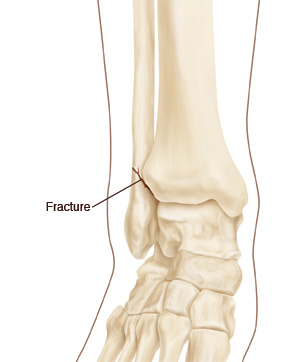
You have an ankle fracture. This means that one or more of the bones that make up the ankle joint are broken. This often causes pain, swelling, and bruising.
A fracture is treated with a splint, cast, or special boot. It will take about 4 to 6 weeks for the fracture to heal. Surgery may be needed to fix severe injuries.
Home care
-
You will be given a splint, cast, or boot to prevent movement at the ankle joint. Unless you were told otherwise, use crutches or a walker. Don’t put weight on the injured leg until cleared by your health care provider to do so. Crutches and walkers can be rented at many pharmacies and surgical or orthopedic supply stores. Don’t put weight on a splint. It will break.
-
Keep your leg raised to reduce pain and swelling. When sleeping, place a pillow under the injured leg. When sitting, support the injured leg so it is raised above the level of your heart. This is very important during the first 48 hours.
-
Apply an ice pack over the injured area for no more than 15 to 20 minutes. Do this every 3 to 6 hours for the first 24 to 48 hours. Keep using ice packs 3 to 4 times a day for the next 2 to 3 days, then as needed to ease pain and swelling. To make an ice pack, put ice cubes in a plastic bag that seals at the top. Wrap the bag in a clean, thin towel or cloth. Never put ice or an ice pack directly on the skin. You can place the ice pack directly over the cast or splint. As the ice melts, be careful that the cast or splint doesn’t get wet.
-
Keep the cast, splint, or boot completely dry at all times. Bathe with your cast, splint, or boot out of the water, protected with 2 large plastic bags. Place 1 bag outside of the other. Tape each bag with duct tape at the top end or use rubber bands. Water can still leak in. So it's best to keep the cast, splint, or boot away from water. If a boot or fiberglass cast or splint gets wet, dry it with a hair dryer on a cool setting.
-
You may use over-the-counter pain medicine to control your pain, unless another pain medicine was prescribed. Talk with your provider before using these medicines if you have chronic liver or kidney disease, ever had a stomach ulcer or gastrointestinal bleeding, or take a blood thinner.
Follow-up care
Follow up with your health care provider in 1 week, or as advised. This is to be sure the bone is healing correctly and in correct alignment. If you were given a splint, it may be changed to a cast or boot at your follow-up visit.
If X-rays were taken, you will be told of any new findings that may affect your care.
When to get medical advice
Contact your health care provider right away if:
-
The plaster cast or splint becomes wet or soft.
-
The fiberglass cast or splint stays wet for more than 24 hours.
-
There is increased tightness, sore areas, or pain under the cast or splint.
-
Your toes become swollen, cold, blue, numb, or tingly.
-
The cast or splint becomes loose.
-
The cast or splint has a bad smell.
-
The cast or splint develops cracks or breaks.
Online Medical Reviewer: Marianne Fraser MSN RN
Online Medical Reviewer: Raymond Turley Jr PA-C
Online Medical Reviewer: Vinita Wadhawan Researcher
Date Last Reviewed: 01/01/2025
© 2000-2026 The StayWell Company, LLC. All rights reserved. This information is not intended as a substitute for professional medical care. Always follow your healthcare professional's instructions.