Lateral ankle ligament reconstruction is a surgery to tighten and firm up 1 or more ligaments on the outside of the ankle. It’s also called the Bröstrom procedure. It’s most often done as an outpatient surgery. This means you can go home the same day.
How the ankle works
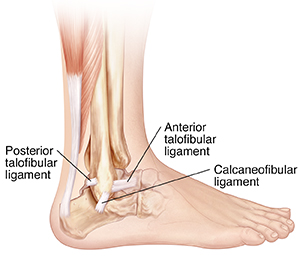
Your ankle is a hinge joint. It lets your foot move up and down. It lets your foot move side to side. Your foot and ankle have several ligaments. These are strong bands of tissue that keep the bones in your ankle and feet tightly connected. You have ligaments on the outer side of your foot. These include the anterior talofibular ligament (ATFL), the calcaneofibular ligament (CFL), and the posterior talofibular ligament (PTFL). These help keep your ankle and foot steady when you walk.
Your ligaments can get weak and loose. This can happen if you have repeated ankle sprains. It can also happen if your foot or ankle is shaped differently from a normal foot and ankle. Weak, loose ligaments can make your ankle become unstable.
Why this surgery is done
You may need this surgery if 1 or more of the ligaments on the outside of your ankle are loose or stretched. This leads to a condition called chronic ankle instability. It can cause chronic pain and repeated ankle sprains. It can make your ankle give way when you walk or do activities.
At first an ankle sprain may stretch and partly tear your ankle ligaments. This first sprain makes it more likely that you'll sprain your ankle again. This is more likely if the first sprain wasn't treated correctly. More sprains may make your ligaments even looser.
Certain problems with your foot can make you more likely to have an unstable ankle. These include:
-
Foot alignment problem.
-
A big toe that sits lower than the other toes.
-
Arch larger than normal.
-
General looseness of your ligaments. This can happen with some conditions, such as Ehlers-Danlos syndrome.
You may have already had physical therapy, bracing, and shoe inserts. A health care provider may advise surgery if these haven’t worked. It’s not common to need this surgery right after a first ankle sprain.
How this surgery is done
Your procedure will be done by an orthopedic surgeon. This is a health care provider who specializes in surgery of bones, ligaments, and tendons. The surgery can be done in a few ways.
-
The surgeon will make a cut (incision) through the skin and muscle of the ankle. Your surgeon will make 1 or more small cuts if your surgery is minimally invasive.
-
They will put small tools and a tiny camera through the cut.
-
The surgeon will lift the ATFL and CFL ankle ligaments from where they attach on a bone of the lower leg (fibula). These ligaments may be made shorter.
-
The ligaments are then reattached to the fibula. This is done using small new holes drilled into the bone. They may be attached using a suture anchor. This is a stitch attached to a bone screw.
Risks of this surgery
Every surgery has risks. Risks of this surgery include:
-
Too much bleeding.
-
Nerve damage.
-
Infection.
-
Stiffness in your ankle joint.
-
Blood clot.
-
Delayed healing.
-
Problems from anesthesia.
-
Your ankle stability doesn't get better.
Your own risks depend on your age, your foot, and your general health. For instance, you may be more likely to have certain problems if you're a smoker. This is also true if you have low bone density. People with diabetes may also have a higher risk for problems.
Talk with your health care provider about any concerns you might have. They can tell you which risks apply most to you.


