Ankle replacement surgery is used to treat arthritis of the ankle joint. It's advised for people with severe ankle arthritis. It also helps treat arthritis that has destroyed the ankle joint surfaces. And it treats ankle pain that restricts daily activities. The damaged ankle joint is removed and replaced with a metal or plastic implant.
The ankle joint
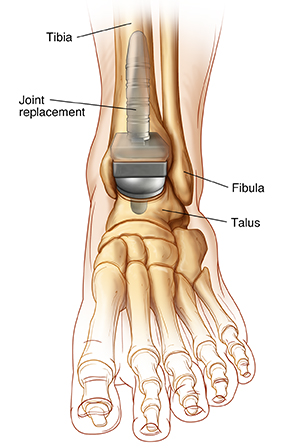
A joint is a place in the body where bones meet. The ankle joint is two joints. One is called the true ankle joint. The shinbone (tibia), fibula (the smaller bone in the lower leg), and talus bones make up this joint. This joint is replaced during this surgery. Parts of the tibia and talus are replaced.
Why ankle replacement surgery is done
The surgery may be a choice for people with severe arthritis of the ankle joint. Arthritis may make it hard to walk without pain. It may make it hard to do daily activities. Surgery is a choice when other treatments haven’t worked well enough. These may include exercises, medicine, bracing, injections, and heat or cold. Ankle replacement surgery can help stop the pain.
How ankle replacement surgery is done
This surgery will be done by an orthopedic surgeon. The surgeon will make a cut (an incision) through the skin and muscle of your ankle. An incision may also be made on your foot. The damaged parts of your shinbone and talus will be removed. The artificial joint components will be attached to your shinbone and talus. A special type of cement may be used to hold them in place. A piece of plastic may be put between the new metal joint pieces. This is so they can glide easily against each other.
Risks of ankle replacement surgery
Every surgery has risks. Your risks vary based on your age and general health. For example, if you are a smoker or if you have low bone density, you may have a higher risk for certain problems such as slow healing. People with diabetes may also have a higher risk for problems such as infections and poor healing. Talk with your surgeon about which risks apply most to you.
Some of the risks of this surgery include:
-
Infection.
-
Damage to nearby nerves.
-
Bleeding.
-
Blood clots.
-
Bones not joining together right.
-
Bones not lining up right.
-
New or worse arthritis in nearby joints.
-
Wearing out or loosening of the new joint.
-
A need for more surgery.
Featured in


