Dismiss Modal

Treatment

¿Qué es la cirugía de reparación del tendón de Aquiles?

Choose a preferred language

El tendón de Aquiles es un cordón fuerte y fibroso que se encuentra en la pantorrilla. Conecta los músculos de la pantorrilla con el talón. Es el tendón más grande del cuerpo. Lo ayuda a caminar, correr y saltar. La cirugía de reparación del tendón de Aquiles repara el tendón dañado.
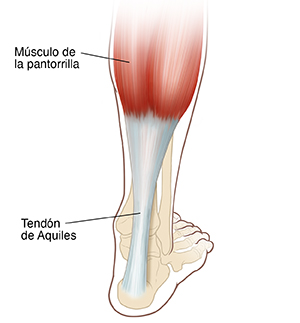
Vista posterior del pie y de la pantorrilla donde se observan los huesos y el tendón de Aquiles.


¿Por qué se hace una cirugía de reparación del tendón de Aquiles?

La cirugía se realiza si sufre una ruptura o desgarro repentino. O bien, si ya presentaba desgaste, uso excesivo, desgarro o lesiones por alguna otra afección. Esta lesión a largo plazo se conoce como tendinitis o tendinopatía.


¿Cómo se hace una cirugía de reparación del tendón de Aquiles?

Un cirujano ortopédico realiza la reparación del tendón de Aquiles. Este cirujano se especializa en tratar problemas de huesos, músculos, articulaciones y tendones. La cirugía puede hacerse de diferentes maneras. El cirujano le hará un corte (una incisión) en la piel y el músculo de la parte posterior de la pantorrilla. Si le hacen una cirugía mínimamente invasiva, el cirujano hará varias incisiones pequeñas en lugar de un solo corte grande. El cirujano le hará un corte en la vaina o el recubrimiento del tendón de Aquiles. Si el tendón está dañado, el cirujano puede quitar la parte dañada y reparar el resto. Si el daño es grave, el cirujano puede usar músculo o tendón de la pantorrilla, el tobillo o el pie para la reparación.


Riesgos de la cirugía de reparación del tendón de Aquiles

Toda cirugía tiene algunos riesgos. Los riesgos de la cirugía para reparar el tendón de Aquiles incluyen los siguientes:

  • Sangrado

  • Lesión en los nervios

  • Infección

  • Coágulos de sangre

  • Dificultades de cicatrización de las heridas

  • Debilidad de la pantorrilla

  • Problemas causados por la anestesia

  • Dolor persistente en el pie y el tobillo

Los riesgos dependen de factores tales como su edad, su estado general de salud y el tipo de cirugía que se realice. También dependen de la forma del pie, los músculos y los tendones. Consulte con el cirujano cuáles son los riesgos más probables en su caso. Hable con él sobre cualquier inquietud que tenga.

Featured in

© 2000-2025 The StayWell Company, LLC. All rights reserved. This information is not intended as a substitute for professional medical care. Always follow your healthcare professional's instructions.

Find the right providers for your needs.

CalOptima Health works with thousands of Orange County providers, including doctors, specialists, health networks, medical groups and more.

Find a Doctor

See Member Health Rewards

CalOptima Health offers health rewards to eligible CalOptima Health members who take an active role in their well-being!

View available rewards
Related Articles
Read article
Orthopedics
Carpal Tunnel Release Surgery

If you have severe carpal tunnel syndrome, you may have carpal tunnel release surgery.

Read article
Orthopedics
Surgery for Shoulder Impingement: Your Experience

Surgery can help free up space in your shoulder joint. This relieves symptoms of impingement. Prepare for surgery as instructed. If you don’t, your surgery may have to be rescheduled. Your healthcare provider will give you instructions for recovering at home. If you have any questions, be sure to get them answered.

Read article
Orthopedics
Foot Surgery: Bunions

A bunion is a bony bump. When the distance between the first and second metatarsal bones of the foot is greater than normal, the big toe may turn toward the other toes. A mild bunion may then form causing foot pain and swelling. Bunions are most often found near the joint at the base of the big toe. Bunions tend to run in families. They may cause pain, swelling, and skin irritation.

Read article
Orthopedics
Understanding Leg Amputation: Surgery for a Medical Condition

This surgery removes part or all your leg. It is done because tissue in the leg is diseased and can't be healed. Or it may be needed to prevent the disease from spreading farther into your body. The goal of the surgery is to restore your ability to function. This is because removing the diseased part of your leg can improve your total health.