Dismiss Modal

Treatment

Inyección en un punto gatillo

Choose a preferred language


¿Qué es un punto gatillo?

Un punto gatillo es un nudo duro y doloroso de fibra muscular. Puede formarse en el punto de tensión o lesión de un músculo. A veces, el nudo puede palparse debajo de la piel. El punto gatillo es muy sensible al tacto. El dolor también puede extenderse a otras partes del músculo afectado. Los músculos que rodean a la rodilla, el omóplato u otros huesos son propensos a los puntos gatillo. Esto se debe a que son más vulnerables a sufrir lesiones.
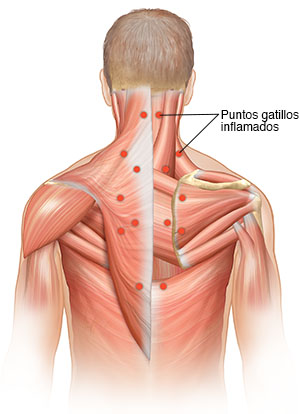
Torso de hombre donde pueden verse músculos superficiales de la espalda. Se muestran los puntos gatillo inflamados.

Sus dolores o espasmos musculares podrían deberse a uno o más puntos gatillo. Su proveedor de atención médica puede tomar la decisión de inyectar los puntos dolorosos para relajar el músculo. Esto puede ayudar a aliviar el dolor. Relajar el músculo también puede mejorar el movimiento. De esta forma, le será posible hacer ejercicios para fortalecer el músculo y ayudarlo a sanar.
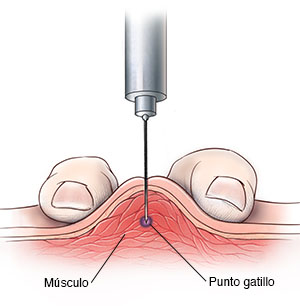
Corte transversal de piel y músculo con dos dedos que comprimen el músculo para insertar la aguja.


Las inyecciones

Cualquier músculo del cuerpo puede tener uno o más puntos gatillo. Es posible que cada punto requiera más de una inyección para lograr un mejor alivio del dolor. Estas inyecciones podrían administrarse en sesiones con un intervalo de separación de 2 semanas aproximadamente. Esto depende de lo que el proveedor considere mejor. En algunos casos, es posible que no sienta una mejoría notable de sus síntomas hasta después de la tercera inyección.


Riesgos y posibles complicaciones

Aunque los riesgos y las complicaciones son muy poco frecuentes, pueden incluir lo siguiente:

  • Infección

  • Sangrado

  • Punción del pulmón (neumotórax o colapso pulmonar)

  • Daño en los nervios

  • Reacción alérgica

© 2000-2025 The StayWell Company, LLC. Todos los derechos reservados. Esta información no pretende sustituir la atención médica profesional. Sólo su médico puede diagnosticar y tratar un problema de salud.

Find the right providers for your needs.

CalOptima Health works with thousands of Orange County providers, including doctors, specialists, health networks, medical groups and more.

Find a Doctor

See Member Health Rewards

CalOptima Health offers health rewards to eligible CalOptima Health members who take an active role in their well-being!

View available rewards
Related Articles
Read article
Orthopedics
Understanding Leg Amputation: Surgery for a Medical Condition

This surgery removes part or all your leg. It is done because tissue in the leg is diseased and can't be healed. Or it may be needed to prevent the disease from spreading farther into your body. The goal of the surgery is to restore your ability to function. This is because removing the diseased part of your leg can improve your total health.

Read article
Orthopedics
Viscosupplementation Treatment for Arthritis

During viscosupplementation treatment for arthritis, your health care provider injects hyaluronic acid into your joint. This thick fluid may help reduce pain and swelling in your arthritic joint (most often, your knee).

Read article
Orthopedics
Foot Surgery: Bunions

A bunion is a bony bump. When the distance between the first and second metatarsal bones of the foot is greater than normal, the big toe may turn toward the other toes. A mild bunion may then form causing foot pain and swelling. Bunions are most often found near the joint at the base of the big toe. Bunions tend to run in families. They may cause pain, swelling, and skin irritation.

Read article
Orthopedics
Understanding Surgical Repair of Skier’s Thumb

Skier's thumb is an injury to the ligament at the base of your thumb. This surgery is to repair or reconstruct the ligament and restore function.