A lumbar epidural injection is an outpatient procedure. This means you go home the same day. It’s often done in a hospital or an outpatient surgery center. Before your shot, your healthcare provider will tell you how to get ready.
Getting ready
You may need to do the following:
-
Give the healthcare provider a list of all over-the-counter and prescription medicines, vitamins, herbs, and supplements. This includes aspirin and anti-inflammatories. (You may need to stop taking some of them before the injection.)
-
Follow any directions you're given for not eating or drinking before the procedure.
-
Arrange for an adult friend or family member to drive you home afterward.
-
Bring any requested X-ray, CT scan, or MRI images on the day of the procedure. Make sure your healthcare provider has an accurate list of any allergies and the reaction associated with them.
During the procedure
The injection takes just a few minutes. But extra time is needed to get ready. You may be given medicine before to help you relax:
-
In some cases, keeping track of devices may be attached to your chest or side. These devices measure your heart rate, breathing, and blood pressure.
-
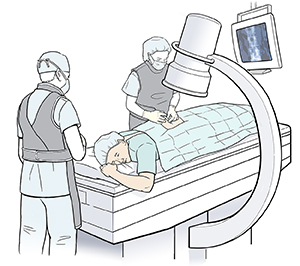
You lie on your stomach or side, depending on where the shot will be given. Your back is cleaned and may be covered with sterile towels.
-
Medicine is given to numb the skin near the place of the shot.
-
If X-ray imaging (fluoroscopy) is to be used, a contrast dye may be injected into your back. This helps your healthcare provider get a better image.
-
A local anesthetic (for numbing), steroids (for reducing inflammation), or both are injected into the epidural space.
The procedure is very safe. But there is a very small risk of infection or local reaction afterward. Get medical care right away if you have:
-
Increasing severe pain
-
Headaches (especially when standing up or sitting upright)
-
Redness
-
Fever of 100.4ºF (38ºC) or higher, or as directed by your healthcare provider
-
Symptoms of infection, including redness or swelling of the injection site
After the procedure
You’ll spend time in a recovery area after the procedure. Before going home, you may be asked to fill out a survey about your pain. Make sure to follow your healthcare provider's instructions about when to follow up.