Dismiss Modal

Treatment

Hip Arthroscopy: Removing Loose Bodies

Choose a preferred language

When pieces of bone or cartilage are loose in your hip joint, they can cause painful joint locking and catching. Using a procedure called arthroscopy, your surgeon can remove any loose bodies from your hip. This procedure uses only small incisions and special tools. One of these tools is an arthroscope. This is a small, tube-shaped tool used to look inside your joints.


In the operating room

Just before surgery, you may be asked several times which hip is to be treated. This is a standard safety measure in the operating room. You will likely receive medicine (anesthesia) to make you sleep or make the area numb, or both.


During the procedure

After you receive anesthesia, your leg is gently pulled to widen your hip joint. Next, your surgeon makes a few small incisions called portals. Through these portals, they insert surgical tools, including the arthroscope. The arthroscope sends images of your joint to a video screen. These images allow your surgeon to look inside your joint. The joint is filled with sterile fluid to help your surgeon see more clearly.


Removing loose bodies

When your surgeon locates the loose bodies in your hip, they will try to remove them using a surgical tool, such as a grasper. But sometimes the loose bodies aren’t small enough to be removed. In this case, your surgeon will break down the loose bodies into smaller pieces. Then, the pieces are removed through the portals. Once your surgeon finishes the procedure, the portals are closed and bandaged. Then you are taken to the recovery room.
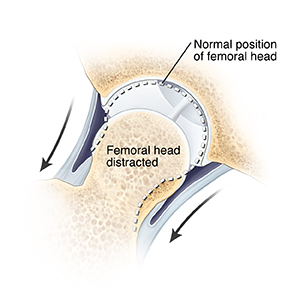
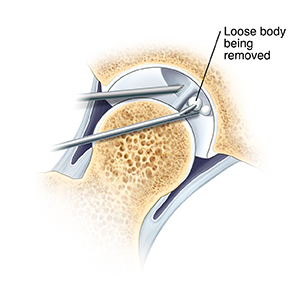
Cross section of hip joint with arrows showing femoral head of thighbone being pulled out of socket. Dotted line shows normal position of femoral head in socket.Cross section of hip joint showing arthroscopic instruments removing loose piece of tissue from joint. Closeup of arthroscope tip in hip joint and instrument removing loose body.

© 2000-2025 The StayWell Company, LLC. All rights reserved. This information is not intended as a substitute for professional medical care. Always follow your healthcare professional's instructions.

Find the right providers for your needs.

CalOptima Health works with thousands of Orange County providers, including doctors, specialists, health networks, medical groups and more.

Find a Doctor

See Member Health Rewards

CalOptima Health offers health rewards to eligible CalOptima Health members who take an active role in their well-being!

View available rewards
Related Articles
Read article
Orthopedics
Microdiskectomy

During a microdiscectomy, some disk is removed. In most cases, bone must first be removed to expose the damaged disk. The part of the disk outer wall and soft center that presses on the nerve can then be removed. There is usually enough disk remaining to cushion the vertebrae.

Read article
Orthopedics
Treating Ganglia

A ganglion is a cystic swelling that is found in overlying joint and tendon sheaths, especially of the wrist. The foot and other extremity areas are sometimes involved. Ganglia can be treated surgically and nonsurgically.

Read article
Orthopedics
Understanding Upper Arm Fracture Open Reduction and Internal Fixation (ORIF)

Open reduction and internal fixation (ORIF) is a type of treatment to fix a broken bone. It puts the pieces of a broken bone back together so they can heal.

Read article
Orthopedics
Hip Arthroscopy: After Surgery

Know what to expect after arthroscopy on your hip.