Dismiss Modal

Treatment

Endoscopic Plantar Fasciotomy (EPF): After Surgery

Choose a preferred language

Have someone drive you home after you have an endoscopic plantar fasciotomy (EPF). Your health care provider may want you to rest at home for a few days. Ask your provider when you can start walking again. If a compression dressing is used to control swelling, you may need to wear a surgical shoe. You may also need to wear a short leg brace for up to 3 weeks.


Recovering at home
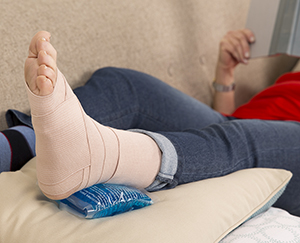
Person on sofa, with foot wrapped in bandages, resting on ice pack, and elevated on pillows.

Expect your foot to feel numb right after the surgery. You’ll probably feel some pain after the local anesthesia wears off. Ice your foot for 10 to 15 minutes several times a day to limit pain and swelling. Raise your foot above heart level as often as you can. If you've been given pain medicines, take them as directed.


Your first post-op visit

Your health care provider may want to see you 1 to 2 weeks after surgery. During this post-op visit, your incisions will be checked to make sure they are healing. The compression dressing may be replaced with a smaller surgical dressing. If this occurs, you can probably start wearing sneakers.


When to call your doctor

Call your health care provider if you have:

  • A bandage that is too tight.

  • A lot of swelling or numbness of your toes.

  • Pain not relieved by medicine.

  • More than a few drops of blood at an incision site.

  • Signs of an infection, such as:

    • A fever of 100.4°F (38°C) or higher, or as directed by your provider.

    • Chills.

    • Redness near the incision.

  • Skin color changes beyond the dressing.

Featured in

© 2000-2025 The StayWell Company, LLC. All rights reserved. This information is not intended as a substitute for professional medical care. Always follow your healthcare professional's instructions.


Find the right providers for your needs.

CalOptima Health works with thousands of Orange County providers, including doctors, specialists, health networks, medical groups and more.

Find a Doctor

See Member Health Rewards

CalOptima Health offers health rewards to eligible CalOptima Health members who take an active role in their well-being!

View available rewards
Related Articles
Read article
Orthopedics
Kneecap (Patella) Surgery: Realignment

Some procedures may be done using arthroscopy, a method that uses tiny incisions and special instruments to look and work inside the knee joint. Other procedures need open surgery. The kneecap can be realigned to improve its tracking. To do this, soft tissue may be cut, tightened, or moved.

Read article
Orthopedics
Foot Surgery: Flexible and Rigid Hammertoes

With hammertoes, one or more toes curl or bend abnormally. This can be caused by an inherited muscle problem, an abnormal bone length, or poor foot mechanics. There are many nonsurgical treatments for hammertoes, but if these are not effective, you may want to consider surgery.

Read article
Orthopedics
What Is Lumbar Microsurgery?

Lumbar microsurgery is a way of doing low-back surgery through a small cut (incision). Learn more about this procedure.

Read article
Orthopedics
Kneecap Surgery: Removing Damaged Cartilage

Surgery may be used when pain severely limits your activities. Or it may be done when a rehab program or other nonsurgical treatments just are not helping enough. Some procedures may be done using arthroscopy. This method uses tiny incisions and special instruments to look and work inside the knee joint. Other procedures need open surgery.