Dismiss Modal

Recovery

After Knee Arthroscopy: Physical Therapy

Choose a preferred language

Your healthcare provider may prescribe physical therapy before or after your surgery or both. This can help ease pain, increase range of motion, and build strength. Your physical therapist will design a program for you. It will be based on your knee problem and recovery goals. This program may have office visits and a home exercise program.


Working with your physical therapist

Your physical therapist can help you set goals and work toward them. But a successful recovery depends mostly on you. Follow instructions and keep your appointments.
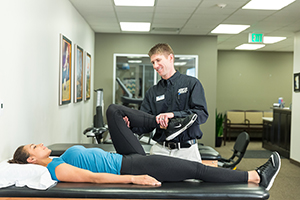
Physical therapist working with woman on leg stretches.


Types of physical therapy

To help you heal, your physical therapist may use one or more of these:

  • Manual therapy. This may include moving soft tissue and joints in a specific way to get back movement and flexibility. It may also include working against the therapist's resistance to improve the way your muscle activates.

  • Weight machines. These machines work to make specific muscle groups stronger.

  • Closed kinetic chain exercises. These help make your joints stronger and more stable by keeping one part of the body still while the rest of the body is moving. Squats are an example of these exercises.

  • Aerobic exercises. These include biking and walking. They build up the leg muscles as well as the heart and lungs.

  • Electric stimulation (as needed). This uses a painless electric current to ease pain, decrease swelling, and rebuild muscles.

  • Ultrasound (as needed). This uses sound waves to help heal injured tissue.

© 2000-2025 The StayWell Company, LLC. All rights reserved. This information is not intended as a substitute for professional medical care. Always follow your healthcare professional's instructions.

Find the right providers for your needs.

CalOptima Health works with thousands of Orange County providers, including doctors, specialists, health networks, medical groups and more.

Find a Doctor

See Member Health Rewards

CalOptima Health offers health rewards to eligible CalOptima Health members who take an active role in their well-being!

View available rewards
Related Articles
Read article
Orthopedics
Discharge Instructions for Osteomyelitis

You've been diagnosed with osteomyelitis, a bone infection caused by bacteria or fungi. Read on to learn how to care for yourself at home.

Read article
Orthopedics
Discharge Instructions: Internal Fixation of a Fractured Femur

Instructions to care for yourself after having internal fixation of a fractured femur.

Read article
Orthopedics
Discharge Instructions for Foot Surgery

Arrange to have an adult drive you home after surgery. If you had general anesthesia, it may take a day or more to fully recover. So, for at least the next 24 hours: Do not drive or use machinery or power tools; do not drink alcohol; and do not make any major decisions.

Read article
Orthopedics
Discharge Instructions: Using Crutches (Weight-Bearing)

Your healthcare provider has prescribed crutches for you. A healthy leg can support your body weight, but when you have an injured leg or foot, you need to keep weight off it. Once you are told that you can put some weight on your leg, use a "weight-bearing" method of walking as the leg heals.