Recovery

After Hip Replacement: Sitting Safely

Choose a preferred language


Learn the safe way to sit to protect your new hip. Follow the instructions below.


Sitting higher

To protect your new hip, you must sit with your knees lower than or level with your hips. To do this, sit in chairs with high seats. Or you can place a firm pillow on the seat of a chair to help raise your hips.
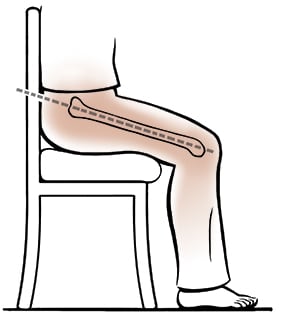
Side view of person seated in higher chair,  showing knee lower than hip.


To sit down

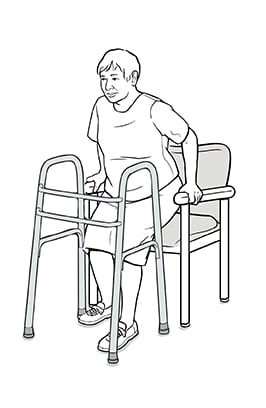
To sit down, back up until the edge of the chair touches your leg. Then, using the armrests to support your weight, lower yourself into the seat. Always keep out in front the leg that was operated on.
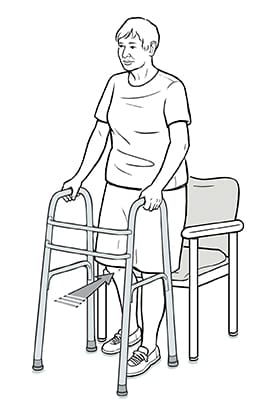
Person using walker backing up into chair so that chair touches back of legs.

Person with hands on arms of chair and lowering self into chair, keeping operated leg slightly out in front.

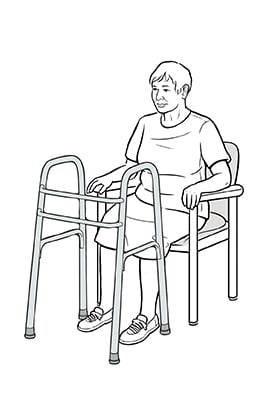
Person seated in chair with hips higher than knees.

© 2000-2026 The StayWell Company, LLC. All rights reserved. This information is not intended as a substitute for professional medical care. Always follow your healthcare professional's instructions.


Find the right providers for your needs.

CalOptima Health works with thousands of Orange County providers, including doctors, specialists, health networks, medical groups and more.

Find a Doctor

See Member Health Rewards

CalOptima Health offers health rewards to eligible CalOptima Health members who take an active role in their well-being!

View available rewards
Related Articles
Read article
Orthopedics
Lumbar Epidural Injection: Recovery at Home

Know what to expect as you recover at home from a lumbar epidural injection.

Read article
Orthopedics
Using Log-Roll to Get Out of Bed (Hip Care)

Here are images showing how to safely get out of bed after a hip replacement.

Read article
Orthopedics
Discharge Instructions for Shoulder Arthroscopy

You had a shoulder arthroscopy. It is a surgical procedure that helps the health care provider diagnose and treat shoulder problems. These include instability, arthritis, and rotator cuff problems. Below are instructions to help you care for your shoulder when you are at home.

Read article
Orthopedics
Discharge Instructions: Using Crutches (Non-Weight-Bearing)

Your healthcare provider has prescribed crutches for you. Follow our step-by-step guide to using crutches.