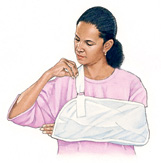
A sling is designed to support your arm in a position of rest. It's used for injuries of the hand, forearm, upper arm, and shoulder.
A shoulder that is immobilized too long can become stiff and lose range of motion. Your elbow can also get stiff. Follow up with your health care provider as advised and don't use the sling longer than directed.
Home use
-
Leave the sling in place as long as directed by your health care provider. Unless told otherwise, you may remove it when bathing, dressing, and when you go to sleep.
-
If approved by your provider, you can do gentle pendulum exercises. To do these:
-
Remove your sling.
-
Stand or sit with your arm vertical and close to your side.
-
Relax your shoulder muscles and gently swing the arm forward and back, side to side, and in small circles.
-
Do this for about 5 minutes once or twice a day.
There should be only minimal pain with this exercise. If you have more than minimal discomfort, stop the exercise and call your provider.
-
-
The sling is adjustable. If it becomes loose, adjust it so that your forearm is horizontal (level with the ground). Your hand should be level with the elbow.
Online Medical Reviewer: Fraser, Marianne, MSN, RN
Online Medical Reviewer: Karlin, Ronald, MD
Date Last Reviewed: 02/01/2025
© 2000-2026 The StayWell Company, LLC. All rights reserved. This information is not intended as a substitute for professional medical care. Always follow your healthcare professional's instructions.