Dismiss Modal

Management

Reducing Knee Pain and Swelling

Choose a preferred language

Many treatments can help reduce pain and swelling in your knee. Your healthcare provider may suggest one or more of the following treatments:

  • Icing your knee. This helps reduce swelling. You may be asked to ice your knee once a day or more. Apply ice for about 15 to 20 minutes at a time, with at least 40 minutes between sessions. To make an ice pack, put ice cubes in a plastic bag that seals at the top. Wrap the bag in a clean, thin towel or cloth. Never put ice or an ice pack directly on your skin.

  • Keeping your leg raised up higher than your heart. This helps excess fluid flow out of your knee joint to reduce swelling.

  • Compression. This means wrapping an elastic bandage or neoprene sleeve snugly around your knees. It keeps fluid from collecting in and around your knee joint.
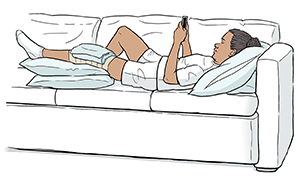
Woman lying on sofa with ice pack on bandaged knee and leg elevated on pillows.

  • Electrical stimulation. This is done by a physical therapist or athletic trainer. It can help reduce excess fluid in your knee joint.

  • Anti-inflammatory medicines. These may be prescribed by your healthcare provider. You may take pills or get shots (injections) in your knee.

  • Isometric (contracting) exercises. These strengthen the muscles that support your knee joint. They also help reduce excess fluid in your knee.

© 2000-2025 The StayWell Company, LLC. All rights reserved. This information is not intended as a substitute for professional medical care. Always follow your healthcare professional's instructions.

Find the right providers for your needs.

CalOptima Health works with thousands of Orange County providers, including doctors, specialists, health networks, medical groups and more.

Find a Doctor

See Member Health Rewards

CalOptima Health offers health rewards to eligible CalOptima Health members who take an active role in their well-being!

View available rewards
Related Articles
Read article
Orthopedics
Back Safety: Pushing and Pulling

Pushing can be hard on your back, but pulling can be even harder. So, push rather than pull when you can.

Read article
Orthopedics
Quadriceps Stretch (Flexibility)

Follow these step-by-step instructions for a quadriceps stretch.

Read article
Orthopedics
Plaster Splint Care

Here are directions to care for your splint at home.

Read article
Orthopedics
Ankle Inversion (Strength)

Follow the step-by-step instructions for this exercise.