What are bones?
Bone is living tissue that makes up the body's skeleton. There are two types of bone tissue:
- Cortical bone. This is the harder, outer tissue of bones.
- Trabecular bone. This is the sponge-like tissue inside bones.
A third type of bone, subchondral bone, is in the joints. It is made of both cortical and trabecular bone. It's located right near cartilage, and it helps with shock absorption when you move your body.
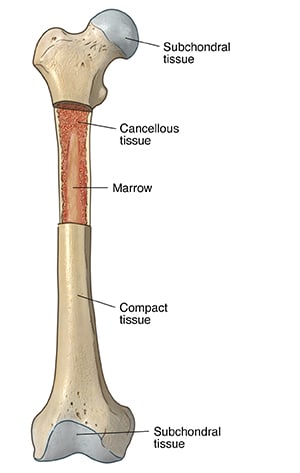
The tough, thin outer membrane covering the bones is called the periosteum. Under the hard outer shell of the periosteum are tunnels and canals. Through these, blood and lymphatic vessels carry nourishment for the bone. Muscles, ligaments, and tendons may attach to the periosteum.
Types of bones
Bones are classified by their shape. They may be long (like the femur and forearm), short (like the wrist and ankle), flat (like the skull), or irregular (like the spine). Primarily, they are referred to as long or short.
There are 206 bones in the adult human skeleton. This doesn't include teeth or the small bones found within tendons called sesamoid bones. The 206 bones include:
- 80 axial bones. These include the skull, hyoid, auditory ossicles, vertebral column, ribs, and sternum.
- 126 appendicular bones. These include the bones of the arms, shoulders, wrists, hands, legs, hips, ankles, and feet.
What are the functions of bones?
Bones give shape and support for the body. They give protection to some organs. Bone also serves as a storage site for minerals. And soft bone marrow in the center of certain bones is where blood cells are formed and stored.
What are the different types of bone cells?
The different types of bone cells include:
- Osteoblast. This type of cell is found along the surface of the bone. Its function is to form new bone tissue, remodel bones while aging, and heal damaged bones.
- Osteoclast. These cells are larger than osteoblasts and are found within the bone itself. Their function is to dissolve, reabsorb, and remove unwanted bone tissue.
- Osteocyte. This type of cell is within the bone. It helps to maintain bone as living tissue.
- Hematopoietic. This type of cell is found in bone marrow. Its function is to make red blood cells, white blood cells, and platelets.
Fat cells are also found in the bone marrow.


