Dismiss Modal

Definition

Skeletal Growth (Child)

Choose a preferred language


A skeleton in progress

  • In babies, the bones in the head aren't fused together. This allows the head to be flexible so it can pass through the birth canal during childbirth. The bones in the skull don’t fully fuse until ages 1 to 2.

  • Children have more dense, elastic tissue (called cartilage) in their joints and other bony structures (such as the ribs). This allows the bones to continue to develop and grow as the child grows. This extra cartilage develops into bone over time. By about age  16, most extra cartilage has matured into bone.

  • Children have growth plates in each long bone. A growth plate is an area of soft bone at each end of the long bones. Growth plates allow the bone to grow as the child grows. The growth plates fuse by the time a child is  14 to 18 years old. 
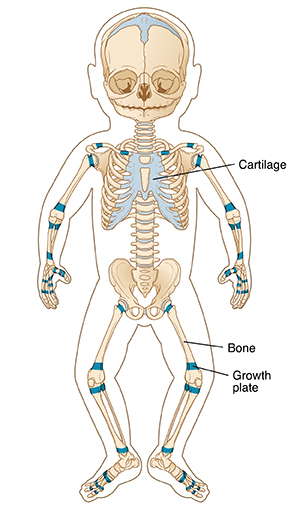
    Front view of infant showing skeleton and growth plates.

Featured in

© 2000-2025 The StayWell Company, LLC. All rights reserved. This information is not intended as a substitute for professional medical care. Always follow your healthcare professional's instructions.

Find the right providers for your needs.

CalOptima Health works with thousands of Orange County providers, including doctors, specialists, health networks, medical groups and more.

Find a Doctor

See Member Health Rewards

CalOptima Health offers health rewards to eligible CalOptima Health members who take an active role in their well-being!

View available rewards
Related Articles
Read article
Lung Health
Treatment for Pulmonary Interstitial Emphysema (PIE)

Pulmonary interstitial emphysema (PIE) is when air gets trapped in the tissue outside the tubes and air sacs of the lungs. It affects newborn babies.

Read article
Hematology
Alpha Thalassemia in Children

Alpha thalassemia is an inherited blood disorder. This means it is passed down through the parent’s genes. It causes anemia in affected children. Learn more about symptoms, diagnosis, and treatment.

Read article
Genetic and Congenital Conditions
When Your Child Has Legg-Calvé-Perthes Disease

Your child has been diagnosed with Legg-Calvé-Perthes (LCP) disease. This is a problem with the head of the thighbone (femoral head). With LCP disease, the blood supply to the femoral head stops. Learn more about causes, symptoms, diagnosis, and treatment.

Read article
Genetic and Congenital Conditions
Flat Head Syndrome (Deformational Plagiocephaly)

Flat head syndrome (deformational plagiocephaly) is when a baby's head develops a lasting flat spot. The flat spot may be either on one side of the head or on the back of the head. This happens when a baby sleeps in the same position most of the time or because of problems with the neck muscles.

