Dismiss Modal

Symptoms

Stages of Labor

Choose a preferred language

Labor has 3 stages. Your healthcare provider may talk about the progress of your labor with certain words. One of these is your baby’s position. Another is your baby’s station. And the effacement and dilation of your cervix will be noted. Read below to learn about these terms and the 3 stages of labor.
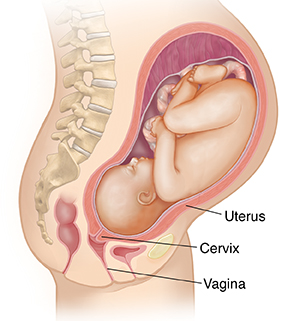
Side view of female body showing pregnancy at 9 months.


Your baby moves into position

Position is your baby’s placement in your uterus. Your baby may be facing left or right. They may be headfirst or feetfirst. Station refers to how far your baby has moved down into your pelvic cavity.


First stage of labor

During the first stage of labor, contractions of the uterus help your cervix thin (efface). They also help it widen (dilate). This will help your baby pass through the vagina (birth canal). At first your contractions won't come that often or last that long. But as time passes, they will come more often, they may be more painful, and they will last longer. They will last about 30 to 60 seconds each. The first stage of labor lasts until the cervix is fully dilated.


Second stage of labor

When your cervix is fully dilated, the second stage of labor begins. In this stage, you will have stronger contractions of your uterus that will help your baby move down the birth canal. They may happen every 2 to 5 minutes. They may last from 45 to 90 seconds each. Your healthcare provider will ask you to push with each contraction. Try to rest between the contractions if you can. Your baby is delivered at the end of this stage of labor.


Third stage of labor

The third stage of labor comes after your baby is born. This is when the afterbirth (placenta) comes out of your uterus. Your uterus will continue to contract. But the contractions are much milder than before.

© 2000-2025 The StayWell Company, LLC. All rights reserved. This information is not intended as a substitute for professional medical care. Always follow your healthcare professional's instructions.

Find the right providers for your needs.

CalOptima Health works with thousands of Orange County providers, including doctors, specialists, health networks, medical groups and more.

Find a Doctor

See Member Health Rewards

CalOptima Health offers health rewards to eligible CalOptima Health members who take an active role in their well-being!

View available rewards
Related Articles
Read article
OB/GYN
Bleeding During Early Pregnancy

Bleeding early in pregnancy isn't uncommon, and in most cases, nothing is wrong. Still, it's a good idea to let your healthcare provider know if it happens.

Read article
OB/GYN
Back Pain During Pregnancy

As your body changes during pregnancy, your back must work in new ways. This can be painful if your back isn't prepared.

Read article
OB/GYN
Abdominal Pain and Early Pregnancy

Some pain and bleeding are common early in pregnancy. Often they stop, and you can go on to have a normal pregnancy. Other times the pain or bleeding can be signs of a miscarriage or ectopic pregnancy. Read on for more information.

Read article
OB/GYN
Pregnancy: Your First Trimester Changes

The first trimester is a time of rapid development for your baby. Read on to learn about all the changes.