Dismiss Modal

Types

Las válvulas del corazón

Choose a preferred language

El corazón tiene cuatro válvulas que se abren y cierran para mover la sangre en la dirección correcta. Cuando el corazón late, la sangre se mueve a través del mismo. Con cada latido, las válvulas se abren y cierran para permitir que la sangre avance. Así, las válvulas mantienen la sangre en movimiento a través del corazón de la manera más eficiente posible.
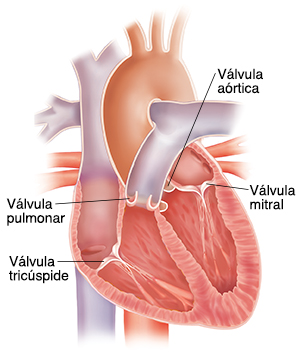
Corte transversal del corazón que muestra las cuatro válvulas.

SPAN: SPAN: CuandoSPAN: el corazón se relajaSPAN: entre latidos:

  • La aurícula izquierda se llena de sangre rica en oxígeno proveniente de los pulmones.

  • La aurícula derecha se llena de sangre escasa en oxígeno proveniente del cuerpo.

SPAN: SPAN: CuandoSPAN: lasSPAN: aurículas laten:

  • La aurícula izquierda aprieta y bombea la sangre hacia el ventrículo izquierdo a través de la válvula mitral.

  • La aurícula derecha aprieta y bombea la sangre hacia el ventrículo derecho a través de la válvula tricúspide.

SPAN: SPAN: CuandoSPAN: losSPAN: ventrículos laten:

  • El ventrículo izquierdo aprieta y bombea la sangre hacia el cuerop a través de la válvula aórtica.

  • El ventrículo derecho aprieta y bombea la sangre hacia los pulmones a través de la válvula pulmonar.
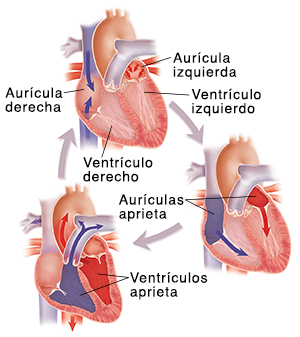

Diagrama con cortes transversales de tres corazones donde puede verse el flujo sanguíneo durante los latidos.

© 2000-2025 The StayWell Company, LLC. Todos los derechos reservados. Esta información no pretende sustituir la atención médica profesional. Sólo su médico puede diagnosticar y tratar un problema de salud.

Find the right providers for your needs.

CalOptima Health works with thousands of Orange County providers, including doctors, specialists, health networks, medical groups and more.

Find a Doctor

Get Care Now

Your health is everything to us. Please reach out for support if you need it.

Get Care Now
Related Articles
Read article
Heart Health
Heart Valve Problems: Aortic Insufficiency

Aortic insufficiency means your aortic valve has problems closing. Blood leaks back through the valve. Extra blood may cause the ventricle to stretch. A stretched ventricle doesn't squeeze as well. In time, the heart won't move blood the way it should.

Read article
Heart Health
Deep Vein Thrombosis (DVT)

Deep vein thrombosis occurs when a blood clot forms in a deep vein. This happens most often in the leg.

Read article
Heart Health
Hypertrophic Cardiomyopathy

Cardiomyopathy means heart muscle disease. If you have cardiomyopathy, you have a problem with the muscle tissue that makes up your heart. Your heart may not be pumping as well as it should. Read on to learn more.

Read article
Heart Health
Aortic Valve Regurgitation

Aortic valve regurgitation is when a person's aortic valve leaks. The aortic valve is 1 of the heart's 4 valves. These valves help the blood flow through the heart and out to the body. Normally, the aortic valve stops blood from flowing back into the left ventricle. With aortic valve regurgitation, some blood leaks back through the valve as the heart relaxes.