Dismiss Modal

Types

Heart Valve Problems: Aortic Stenosis

Choose a preferred language

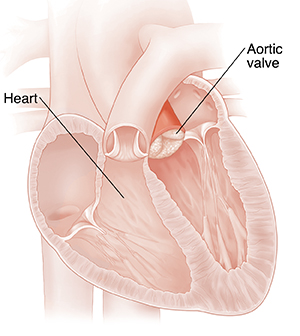
Aortic stenosis means your aortic valve has a problem opening. The aortic valve is one of the heart’s four valves. It's on the left side of the heart. It sits between the left lower chamber (left ventricle) and the large blood vessel that sends blood to the body (aorta). With aortic stenosis, the left ventricle has to work harder to push the blood through the valve. In some cases, this extra work will make the muscle of the ventricle thicken. In time, the extra work can tire the heart and cause the heart muscle to weaken.

Stenosis usually gets worse slowly, over many years. But sometimes, it can quickly get worse.
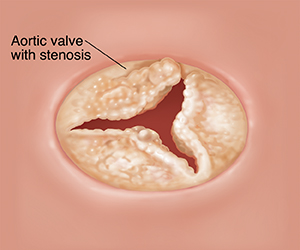
Top view of open aortic valve with stenosis.Cross section of heart showing aortic valve with stenosis.


Possible causes

Calcium deposits can form on the aortic valve as you get older. These deposits make the valve stiff and hard to open. In some cases, you may have been born with an abnormal aortic valve. Or your aortic valve may have been damaged by rheumatic fever or a heart infection. Radiation therapy used as treatment for cancers such as lymphoma, may be a cause.


Treating aortic stenosis

In many cases, treatment won’t be needed unless you have symptoms. If you do have symptoms, medicines may help ease them. If the stenosis is severe, your healthcare provider may advise surgery to replace the valve. Or you may have a catheter-based procedure (transcatheter aortic valve replacement or TAVR) to replace the valve, even if you don’t have symptoms.


© 2000-2025 The StayWell Company, LLC. All rights reserved. This information is not intended as a substitute for professional medical care. Always follow your healthcare professional's instructions.

Find the right providers for your needs.

CalOptima Health works with thousands of Orange County providers, including doctors, specialists, health networks, medical groups and more.

Find a Doctor

Get Care Now

Your health is everything to us. Please reach out for support if you need it.

Get Care Now
Related Articles
Read article
Heart Health
Takotsubo Cardiomyopathy

Takotsubo cardiomyopathy (TCM) is a type of heart condition. It causes sudden chest pain. The symptoms of TCM can look like a heart attack.

Read article
Heart Health
Unstable Angina

There are 2 types of angina, stable and unstable. Stable angina occurs at certain times and can often be managed. Unstable angina occurs at uncertain times. It may not get better with the usual forms of treatment for angina. It is a warning that a heart attack (acute myocardial infarction) is possible in the near future.

Read article
Heart Health
Angina Pectoris

Angina pectoris is chest pain or a feeling of chest discomfort that occurs when a part of your heart doesn't get enough blood and oxygen. Learn more about angina, including causes, risks, symptoms, diagnosis, treatment, and prevention.

Read article
Heart Health
Ventricular Arrhythmia

Sometimes problems with the heart's electrical signals lead to a fast heart rhythm. Too many signals may make the heart beat very fast (tachycardia). Or signals may be sent so rapidly and irregularly that the heart muscle sometimes quivers and doesn't beat at all (fibrillation).