Dismiss Modal

Treatment

Creating a Hemodialysis Access

Choose a preferred language

Before hemodialysis can be done, a way for blood to leave and return to your body (an access) is needed. During hemodialysis, needles placed into the access carry blood to and from the dialyzer. A hemodialysis access is often made in your arm. The 2 main types of accesses are an arteriovenous fistula (AV fistula) and an arteriovenous graft (AV graft).


Making your access

The hemodialysis access provides a large volume of fast flowing blood. It involves surgery under anesthesia. You may be able to go home the same day. It is made during a short procedure using 1 of these methods:

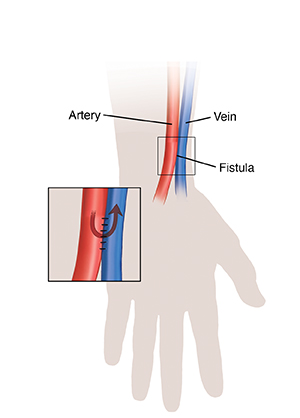
  • A fistula is made by linking an artery to a nearby vein. The high pressure and blood flow in the artery are transferred into the vein. They help the vein grow in size and thickness. The enlarged vein (fistula) eventually has high blood flow. It becomes thick enough for needles to be placed safely several times each week during hemodialysis. It may need weeks or months to develop before it's ready to be used. A fistula works better than the graft. It also has fewer long-term problems. It is the preferred form of access.

    Silhouette of hand and wrist showing fistula for hemodialysis. Inset shows blood flow through fistula.

  • A graft (piece of synthetic tube) may be sewn between an artery and a vein. It's often used if a fistula is not possible because of the small size of your veins. Blood flows quickly through the graft from the artery to the vein. A graft is often ready to use in a few weeks. Needles can be placed into the plastic tube to get blood during dialysis.
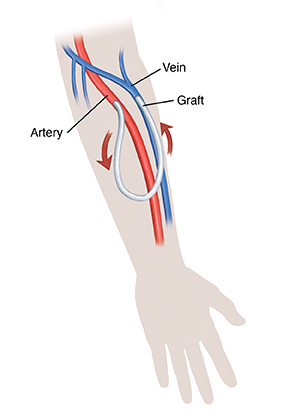
    Silhouette of hand and forearm showing graft for hemodialysis. Arrows show blood flow through graft.

Both types of access may take weeks to months before they can be used. If dialysis is needed right away, a short-term venous catheter is used. A catheter that allows two-way blood flow is placed into a large vein. The dialysis tubing is then connected to the catheter. If both the AV fistula and graft don't work, a more permanent venous catheter is used.

The most common complications for hemodialysis access are:

  • Infection

  • Clotting

  • Decreased blood flow from clotting or other narrowing

© 2000-2025 The StayWell Company, LLC. All rights reserved. This information is not intended as a substitute for professional medical care. Always follow your healthcare professional's instructions.

Find the right providers for your needs.

CalOptima Health works with thousands of Orange County providers, including doctors, specialists, health networks, medical groups and more.

Find a Doctor

Get Care Now

Your health is everything to us. Please reach out for support if you need it.

Get Care Now
Related Articles
Read article
Heart Health
Risks and Complications of Angiography

Angiography is safe. But any procedure has risks and possible complications. Before you have any procedure, you should understand the possible risks. Here are the common risks for angiography.

Read article
Heart Health
Hemodialysis

Hemodialysis is a type of treatment for kidney failure (also called end-stage kidney disease or ESRD). It uses a machine that holds a filter called a dialyzer. As blood flows through the dialyzer, waste is removed and fluid and chemicals are balanced. Hemodialysis treatments are usually done at a special dialysis center.

Read article
Urology
Ureterolysis

Pressure from a mass of tissue or scar tissue is blocking one or both of your ureters. This causes urine to back up into the kidneys instead of flowing out of the body. Ureterolysis can help treat this problem. With this surgery, the ureter is freed from the tissue that is pressing on it. The ureter is then moved to a new position away from the blockage. Read on to learn about this procedure.

Read article
Urology
Kidney Disease: Getting the Right Amount of Protein

If your kidneys can't filter wastes from your blood normally, the BUN (blood urea nitrogen) level increases. If the level gets too high, you can become sick. Because of this, you need to control the amount of protein you eat each day. Use this handout to help you.