Dismiss Modal

Management

How to Take Your Pulse

Choose a preferred language

Taking your pulse is a way to measure your heart rate. When you take your pulse, you are feeling the force of blood as it’s pumped from your heart into your body. You may be asked to take your pulse regularly. Or you may just need to take it when you exercise or when you feel something is wrong.
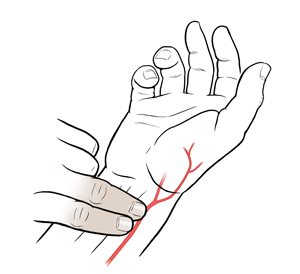
Hand palm side up showing location of radial artery, with two fingers from opposite hand taking radial pulse.


Step 1. Find your pulse

  • With your first 2 fingers, press lightly on the inside of your wrist, just below the base of the thumb. You should not be pressing on a bone. Don't use your thumb.

  • The beats you feel are your pulse. If you can’t find your pulse, try moving your fingers slightly to a new spot.


Step 2. Take your pulse

  • Count the beats you feel in your wrist as you watch the second hand on a clock. You may be told to count the beats for 30 seconds, then multiply that number by 2. Or you may be told to count for a full minute. Both methods should give you about the same result.

  • The number you get is your pulse measurement. It's measured in beats per minute (bpm). A normal pulse when you are at rest is between 60 and 100 beats per minute. The beats should be regular (evenly spaced). If the beats are not regularly spaced, let your health care provider know.


Step 3. Write down the results

  • Write down your pulse each time you take it. You may be asked to bring your results with you each time you visit your provider.


© 2000-2025 The StayWell Company, LLC. All rights reserved. This information is not intended as a substitute for professional medical care. Always follow your healthcare professional's instructions.

Find the right providers for your needs.

CalOptima Health works with thousands of Orange County providers, including doctors, specialists, health networks, medical groups and more.

Find a Doctor

Get Care Now

Your health is everything to us. Please reach out for support if you need it.

Get Care Now
Related Articles
Read article
Heart Health
Event Monitor

An event monitor is a portable device used to record your heart's electrical activity when you have symptoms. It records the same information as an electrocardiogram (ECG), but for longer durations of time. Most of these devices can send the recorded information directly to your healthcare provider. This allows him or her to analyze the electrical activity of your heart while you are having symptoms.

Read article
Heart Health
Coping with Heart Failure

When you're living with heart failure, it's normal to feel sad or down at times. Here are some tips to help you feel better and get the help you need.

Read article
Heart Health
Medicines for Cardiomyopathy

Medicines can help you feel better and stay as healthy as you can. Take your medicines exactly as instructed. Never stop taking medicines or change dosage unless told to by your doctor, even if you feel better. Here are some capsule definitions of medicines that might be prescribed.

Read article
Heart Health
Heart Failure Zones: Your Action Plan

This sheet will help you assess your heart health each day. It lists symptoms to watch out for, and action steps to take.