Dismiss Modal

Diagnosis

Checking Your Blood Pressure at Home

Choose a preferred language

Keeping track of your blood pressure at home can be a good way for you and your healthcare provider to learn how your blood pressure changes during the day. You can use one of two types of blood pressure monitors. Each has pros and cons.
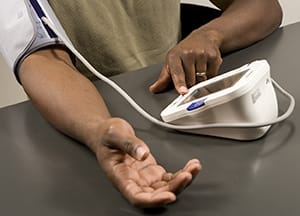
Man using home blood pressure monitor.


Aneroid monitors

This type of monitor has a cuff that you inflate by hand and a dial gauge with a pointer. Most models are easy to carry. They are often inexpensive. Some models have easy-to-read gauges and a special cuff that lets you work it with one hand. These monitors need to be adjusted at least once a year. These are very accurate but can be hard to read.


Digital monitors

These monitors are easy to use and read. Most digital monitors are portable and can be used with one hand. Keep in mind that digital monitors are sensitive to body movement. They don't work well on certain people. They also need electricity or batteries and are more expensive than aneroid monitors. 

Talk with your healthcare provider about which type might be best for you. No matter what kind of monitor you use, take it with you to your provider's office. You can compare it with the monitor in the office and check that it is accurate. 


Tips for buying a blood pressure monitor

  • The American Heart Association (AHA) recommends an automatic monitor that uses a cuff that goes on your upper arm (bicep).

  • The AHA doesn't recommend wrist and finger monitors. This is because their results are not as reliable as the upper arm monitors.

  • Check that the monitor meets the U.S. Blood Pressure Validated Device Listing criteria. See www.validatebp.org for more information.

  • Check that the monitor is approved for children, pregnant women, and older adults if it's to be used for these groups.

  • People with smaller or larger arms may need a special cuff size. Measure around the upper arm. Choose a monitor that comes with the correct cuff size.

  • Check your monitor's reading with your healthcare provider's reading when the device is new. Check it once a year after that.

  • Monitors can wear out over time. They may no longer be able to be adjusted. You may have to replace your monitor if the measurements are very different from the measurements made at your provider's office.

Author: Perry, Joan

Copyright Health Ink & Vitality Communications


Find the right providers for your needs.

CalOptima Health works with thousands of Orange County providers, including doctors, specialists, health networks, medical groups and more.

Find a Doctor

Get Care Now

Your health is everything to us. Please reach out for support if you need it.

Get Care Now
Related Articles
Read article
Heart Health
Chest Echocardiography (Transthoracic)

A transthoracic echocardiogram (echo) is an imaging test. It helps your doctor assess your heart. Here's how it works.

Read article
Heart Health
Diagnosing Heart Valve Problems

A problem with a heart valve will usually cause the heart to make a noise. Your provider can hear this noise, called a murmur. But you can have a heart murmur and not have valve disease or any other heart problem. Other tests can help confirm the diagnosis of valve disease.

Read article
Heart Health
Electrocardiogram (ECG)

The ECG is a test that records electrical signals from your heart. The pattern of these signals can tell the healthcare provider if your heart is normal, under stress, or having electrical problems, strain, or damage.

Read article
Heart Health
Cardiopulmonary Exercise Test (CPET)

This test tells how much air moves in and out of your lungs when you exercise. During the test, you may be asked to walk on a treadmill or ride on a stationary bike. Read on to learn what to expect before, during, and after the test.