Dismiss Modal

Types

When Your Child Has Mastoiditis

Choose a preferred language

Your child has mastoiditis. This is an infection of the mastoid—he hard, bony area located right behind the ear. It's most often the result of an infection that started in the middle ear and spread to the bone.
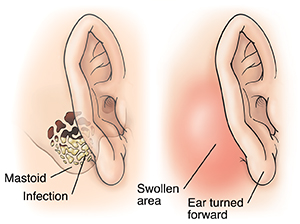
Side view of ear showing infection in mastoid bone. SIde view of ear showing swollen area behind ear, pushing ear forward.


Who is at risk for mastoiditis?

Mastoiditis is more common in children than adults. Having any of the following may make getting it more likely:

  • An ear infection

  • Eustachian tube problems

  • A problem with the immune system


What are the symptoms of mastoiditis?

  • Fever

  • Ear pain

  • Swelling over the mastoid bone (bone behind the ear), causing the ear to turn forward

  • Redness, tenderness, or swelling behind the ear

  • Drainage from the ear canal or dizziness

  • Weakened facial muscles (uncommon)


How is mastoiditis diagnosed?

Your child’s healthcare provider will ask about your child’s medical history. They will also do a physical exam. This helps find the best treatment. An imaging test such as CT scan or MRI may be done to help the healthcare provider make a diagnosis and view the mastoid area.


How is mastoiditis treated?

If mastoiditis is suspected, your child may be admitted into the hospital for evaluation and treatment. The hospital stay can last for 5 to 7 days or more. In the hospital, your child will be given IV (intravenous) antibiotics for the infection. Your child will see an otolaryngologist. This is a doctor who specializes in treating problems of the ears, nose, and throat (ENT). The ENT doctor may need to make a tiny incision in the eardrum to allow trapped fluid to drain out. This is called a myringotomy. It relieves pressure and the fluid can be tested. The test results help the ENT doctor determine which antibiotic to give your child. If these treatments don’t work, your child may need surgery to remove parts of the infected mastoid. This is called a mastoidectomy.


Long-term concerns

Once treated, the mastoid often causes no long-term problems. But if left untreated, mastoiditis can lead to a serious infection in and around the brain. To protect your child’s health, follow up with their regular healthcare provider.


© 2000-2025 The StayWell Company, LLC. All rights reserved. This information is not intended as a substitute for professional medical care. Always follow your healthcare professional's instructions.

Find the right providers for your needs.

CalOptima Health works with thousands of Orange County providers, including doctors, specialists, health networks, medical groups and more.

Find a Doctor

Get Care Now

Your health is everything to us. Please reach out for support if you need it.

Get Care Now
Related Articles
Read article
Ear, Nose, and Throat
When Your Child Has Swimmer's Ear

If your child spends a lot of time in the water and is having ear pain, he or she may have developed otitis externa. This is also known as "swimmer's ear."

Read article
Ear, Nose, and Throat
Ruptured Eardrum, Traumatic

A ruptured eardrum will cause pain. There may be some clear or bloody drainage. A buzzing sound may be heard in the ear. Some hearing may be lost the affected ear.

Read article
Ear, Nose, and Throat
Ruptured Infected Eardrum (Child)

The infection in your child's eardrum may be treated with antibiotics. The eardrum usually heals completely on its own.

Read article
Ear, Nose, and Throat
When Your Child Has Pharyngitis or Tonsillitis

Your child's throat feels sore. This is likely because of redness and swelling of the throat.