Dismiss Modal

Types

Types of Brain Aneurysms

Choose a preferred language

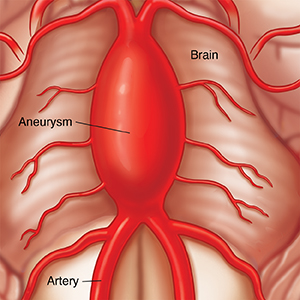
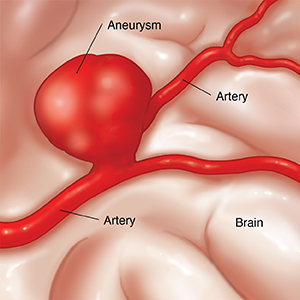
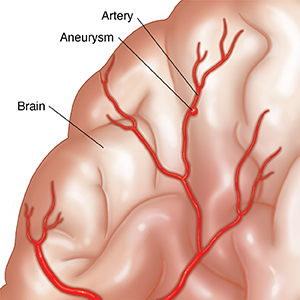
There are several types of brain aneurysms that are classified by shape. These are saccular (also called berry) aneurysms, which are by far the most common. Less common are the fusiform and dissecting types. Brain aneurysms may also be classified by:

  • Size (small, large, and giant)

  • Location

  • Cause (such as a mycotic aneurysm, caused by an infection)

Most aneurysms occur where an artery branches, often at the base of the brain. The risk of an aneurysm bursting (rupturing) can be affected by the shape and location of the aneurysm. The treatment options vary, depending on the type of aneurysm, its size, and its location.
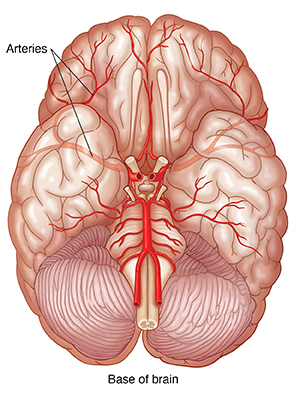
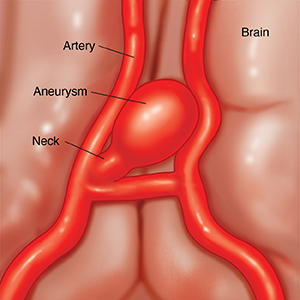
Brain viewed from bottom showing brain stem, cerebellum, and arteries.

Closeup of brain showing artery with saccular aneurysm.

Closeup of brain showing artery with fusiform aneurysm.

Closeup of brain showing giant aneurysm involving two arteries.

Closeup of brain showing mycotic aneurysm on artery.

© 2000-2025 The StayWell Company, LLC. All rights reserved. This information is not intended as a substitute for professional medical care. Always follow your healthcare professional's instructions.

Related Articles
Read article
Brain Health
Understanding Functional Dystonia

Functional dystonia is a condition that causes muscle spasms (contractions) you can’t control. Dystonia causes clenching, bending, or twisting or limbs or joints.

Read article
Brain Health
Dermoid Cyst of the Brain or Spinal Cord

A dermoid cyst is the growth of normal tissue in an abnormal place in the body. The cyst is benign (not cancer). It contains different types of tissue, such as hair follicles, cartilage, sweat glands, and glands that make skin oils. A dermoid cyst in the brain or spinal cord is a rare type of dermoid cyst. They often appear in children under age 10, but can also appear in older children and young adults.

Read article
Brain Health
Subarachnoid Hemorrhage

A subarachnoid hemorrhage means that there is bleeding in the space that surrounds the brain. Most often, it occurs when a weakened area in a blood vessel (aneurysm) on the surface of the brain bursts and leaks. The blood then builds up around the brain and inside the skull increasing pressure on the brain. This can cause brain cell damage, life-long complications, and disabilities.

Read article
Brain Health
Understanding Progressive Supranuclear Palsy

Progressive supranuclear palsy (PSP) is a disease that changes your brain. The symptoms get worse over time.