Dismiss Modal

Types

Cervical disk problems

Choose a preferred language

The spine has 3 natural curves. The cervical curve is in the neck. It forms the top part of the spine. This part is also known as the cervical spine. This sheet tells you more about the parts of the cervical spine and damaged disks. This is a common problem that can affect the cervical spine. Most people don't need surgery for this. 


A healthy cervical spine

The spine is made up of these parts:

  • Vertebrae. These are bones stacked like building blocks that make up the spine. The neck contains the first 7 vertebrae of the spine.

  • Disks. These are small pads of tissue that lie between the vertebrae. They help cushion and protect the vertebrae and allow your spine to move.

  • The spinal cord. This nerve tissue runs through a large central opening (spinal canal) formed by the vertebrae.

  • Nerve root. These branch out from the spinal cord and carry signals to the body.

  • Foramina. These are smaller openings on each side of the vertebrae. Nerve roots and the nerves they form lead to your neck, shoulders, arms, and hands from the spinal cord through these openings.
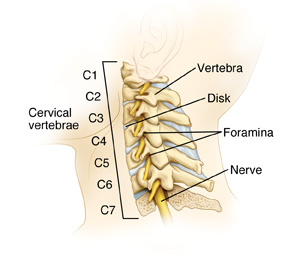
Side view of cervical spine with lowest vertebra in cross section to show spinal cord.


Damaged disks in the cervical spine

A common cervical spine problem is a damaged disk. A disk may be injured by a sudden movement. This can cause a disk to bulge or break open (herniate). Or a disk may wear out slowly over time (degenerate). A worn-out disk may become very flat. Then the vertebrae above and below it touch or slip back and forth. As disks wear out, abnormal bone growths (bone spurs) can form on the vertebrae. Bone spurs can also form in the foramina. This causes them to narrow (stenosis) and press on the nerve root.

If your healthcare provider thinks that you have a damaged disk, you may have tests to confirm the problem. You may have any of these:

  • MRI

  • CT scan

  • Flexion-extension X-ray films

  • Electromyography (EMG)

  • Nerve conduction studies

Your healthcare provider will then work with you to plan treatment as needed. 
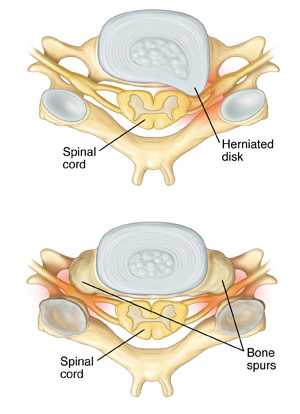
Top view of cervical vertebra showing herniated disk. Top view of cervical vertebra showing bone spurs.

© 2000-2025 The StayWell Company, LLC. All rights reserved. This information is not intended as a substitute for professional medical care. Always follow your healthcare professional's instructions.

Find the right providers for your needs.

CalOptima Health works with thousands of Orange County providers, including doctors, specialists, health networks, medical groups and more.

Find a Doctor

Get Care Now

Your health is everything to us. Please reach out for support if you need it.

Get Care Now
Related Articles
Read article
Brain Health
Dermoid Cyst of the Brain or Spinal Cord

A dermoid cyst is the growth of normal tissue in an abnormal place in the body. The cyst is benign (not cancer). It contains different types of tissue, such as hair follicles, cartilage, sweat glands, and glands that make skin oils. A dermoid cyst in the brain or spinal cord is a rare type of dermoid cyst. They often appear in children under age 10, but can also appear in older children and young adults.

Read article
Brain Health
Migraine Headache

A migraine is a type of headache that's often severe. Learn about migraines, including symptoms, triggers, and how to care for yourself at home.

Read article
Brain Health
Paresthesia

Paresthesia is a burning or prickling feeling that's sometimes felt in the hands, arms, legs or feet. It can also occur in other parts of the body. Learn details about home care after seeing your health care provider.

Read article
Brain Health
Autonomic Dysreflexia

People with spinal cord injury (SCI) may be at risk for a serious problem called autonomic dysreflexia (AD). If you have an SCI at level T6 or higher, you should be aware of this problem and how it could affect you.